Content
Content

Law and public safety
Law and public safety is a broad sector that covers justice and the courts, New Zealand Police, and Fire and Emergency New Zealand.
9.1. Institutional structure
Service delivery responsibilities
- The Ministry of Justice owns and operates the portfolio of buildings that comprise the New Zealand court system. The court system operates a hierarchical structure, with each level of court having specific jurisdiction and appeal pathways, which is funded and managed through the Ministry’s annual budget.
- New Zealand Police is headquartered in Wellington with 12 police districts, each with a central station and a network of subsidiary and suburban stations. As of November 2025, there were 295 police stations across New Zealand, ranging from large, 24-hour central stations in major urban centres to smaller community policing centres in suburban and rural areas. The property portfolio is owned and managed centrally, although some land is owned by iwi and some buildings are leased.
- Fire and Emergency New Zealand (FENZ) is New Zealand’s main firefighting and emergency services organisation, owning over 600 fire stations and around 1,280 fire trucks and specialist vehicles. They attend a significant number of incidents – not just fires, but other events like urban search and rescue. FENZ also acts as a regulator for fire safety, issuing fire permits and undertaking enforcement activities based on its regulatory duties.
Governance and oversight
- The Ministry of Justice is the lead agency for the justice sector, responsible for justice policy and legislation, court administration, and constitutional issues. It also chairs the Justice Sector Leadership Board (JSLB) to coordinate with other justice sector agencies, of which both Police and Corrections are members.
- Justice and Police are public service departments accountable to their own Ministers.
- Independent oversight is provided by bodies such as the Independent Police Conduct Authority (IPCA). The judiciary, while operating within facilities managed by the Ministry of Justice, is constitutionally independent of the executive government, a crucial element of governance.
- FENZ was founded as a Crown entity under the Fire and Emergency New Zealand Act 2017, amalgamating 40 organisations. FENZ has its own board and is accountable to the Minister of Internal Affairs. The Department of Internal Affairs is responsible for overseeing FENZ, including financial performance and strategic direction.
9.2. Paying for investment
- Justice and Police receive individual annual parliamentary appropriations that are funded through general taxation. These appropriations include both capital and operating expenditure. Significant projects that require large amounts of capital are subject to a separate business case and Budget bid process. The Ministry of Justice collects minimal revenue from filing fees, which are largely used for operating expenditure.
- FENZ is funded through the fire services levy placed on property insurance contracts and Crown funding for public good services.
9.3. Historical investment drivers
- Most investment in Justice is driven by the need to modernise ageing buildings, improve security, and incorporate technology for more efficient processes. Investment in new infrastructure is tied to population-driven demands, as a larger population will require greater capacity to process those charged with crimes. Government policy approaches to crime will also determine demand volumes for courts.
- Like Justice, Police investment is driven by a mix of maintenance, renewals, population growth and Government policy. In recent times, changes in policing strategy, such as a move towards community-based policing, have influenced investment in smaller, more localised police stations and bases.
- When established in 2017, FENZ inherited assets from 40 organisations with varying levels of investment need. Renewals are consistently a large driver of investment for FENZ, as fire appliances make up a large portion of its asset base and they generally have an operating life of 20 to 25 years.
- For all these sectors, local population dynamics are important considerations for future demand. For instance, consolidation of the fire service drove significant rationalisation investment in station co-location and upgrades, fleet standardisation and communications infrastructure integration. Investments in digital technologies have helped to improve the quality and reliability of emergency services.
9.4. Community perceptions and expectations
This section summarises what we know about the New Zealand public’s perceptions and expectations of the law and public safety sector, at a national level.
- There is very little data available that represents New Zealanders’ preferences and expectations for law and public safety infrastructure. Generally, studies ask about spending on different types of public services, rather than asking specifically about the infrastructure that enables those services.
- However, while most New Zealanders do not indicate that concern for crime is a top priority, spending more on police and law enforcement as a priority appears to be a preference for most people.202
9.5. Current state of network
- As of 2024, the Ministry of Justice’s capital assets (excluding land) were valued at about $1.2 billion. The value of Justice assets has increased 136% since 2004 in real terms.
- In 2024, Police had capital assets of about $710 million. Police assets have only grown 20% since 2004 in real terms. There was an elevated period of investment from 2009 through to 2013. Outside of that, there were multiple time periods where the value of assets declined, indicating a wearing out of the capital stock.
- Based on data available since 2007, investment (such as additions of fixed assets) in Justice and Police assets has averaged about $215 million per year.
- From an asset perspective, FENZ own and operate over 600 fire stations, as well as three communication centres, five regional offices, and their corporate headquarters. FENZ has over 1,280 fire trucks and specialist vehicles. The estimated physical asset base (property and equipment) is approximately $1.5 billion, 60% of which is in buildings, and 20% in fire appliances. The late 2010s saw FENZ investing significantly to upgrade its buildings, but outside of that period, investment has been relatively subdued.
- We don’t have full information on building condition, but we can observe the extent to which total investment is keeping up with depreciation. (Note: If investment falls below depreciation, this implies assets are being ‘sweated out’. However, even if investment is above depreciation, if that investment is directed to new infrastructure, it is still possible that existing assets are deteriorating at the expense of new infrastructure. In the absence of knowing renewal investment to depreciation specifically, the higher the ratio the better the overall condition of the asset base.)
- The investment to depreciation ratios for Justice and Police averaged 131% and 107% respectively since 2007. These averages mask significant ebbs and flows. For instance, we estimate ratios were well below 100% for Police in the late 2010s, while Justice saw ratios at or below 70% around the early 2020s. For FENZ, since 2000203 we estimate the investment to depreciation ratio has been 125%, with the ratio a bit higher since 2017 when FENZ was established (145%). Because investment was also required to respond to population and income growth, this suggests renewal-focussed investment may have been below the level required by depreciation.
- Much of the courthouse estate is ageing, with many buildings requiring seismic strengthening, security upgrades, and modernisation to be fit for purpose. Court capacity is also an important factor, with Budget 2025 allocating $245.5 million over four years to address pressures in the courts and legal aid.
9.6. Forward Guidance for capital investment
Forecast investment levels for law and public safety

Note: Spending is modelled for law and public safety as a whole, then broken down into each subsector’s estimated relative share of total government public administration and safety, using estimates of capital stock and investment over the past 10 to 20 years. *Police’s range is wider than the other two sectors because it’s relative share varies depending upon on the measure – historical investment share or historical capital stock share.
- The Commission’s Forward Guidance for Justice, Police, and FENZ are largely reflective of these agencies’ relative importance within the overall public administration and safety sector delivery activities.
9.7. Current investment intentions
- The current Government has implemented a focus on policing and justice policy approaches, including a stronger police presence and longer sentences, especially for three strikes violent and sexual offences. This approach will require increases in operational funding across the justice sector, but also complementary infrastructure investment to support the expected increased service levels.
- For justice and public safety, our Forward Guidance is largely a multi-year indicative projection, rather than an annual target. As such, we have excluded it from the chart below.
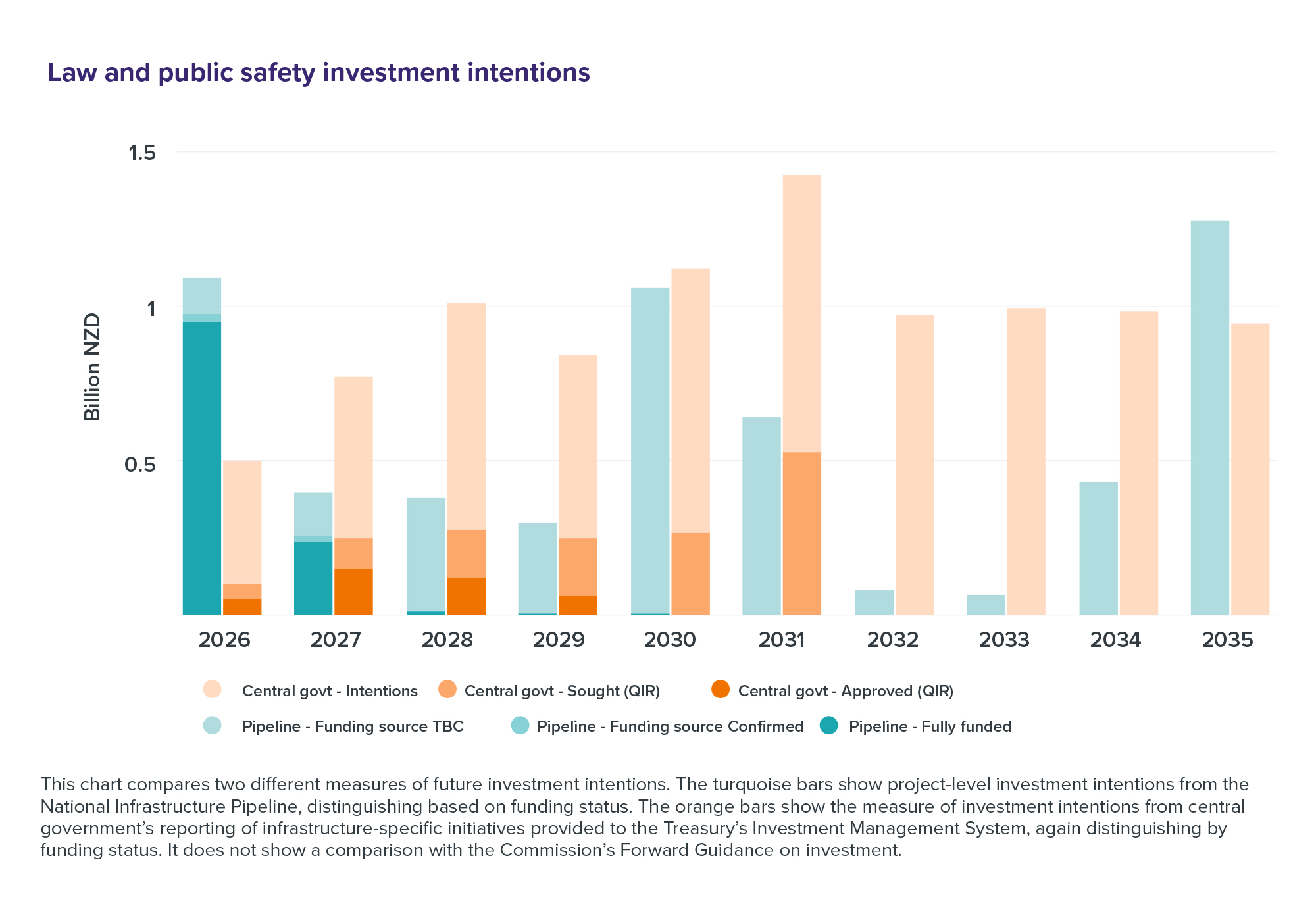
- Beyond the first two years in the Pipeline, funding is uncertain for these projects.
Figure 54: Law and public safety investment intentions
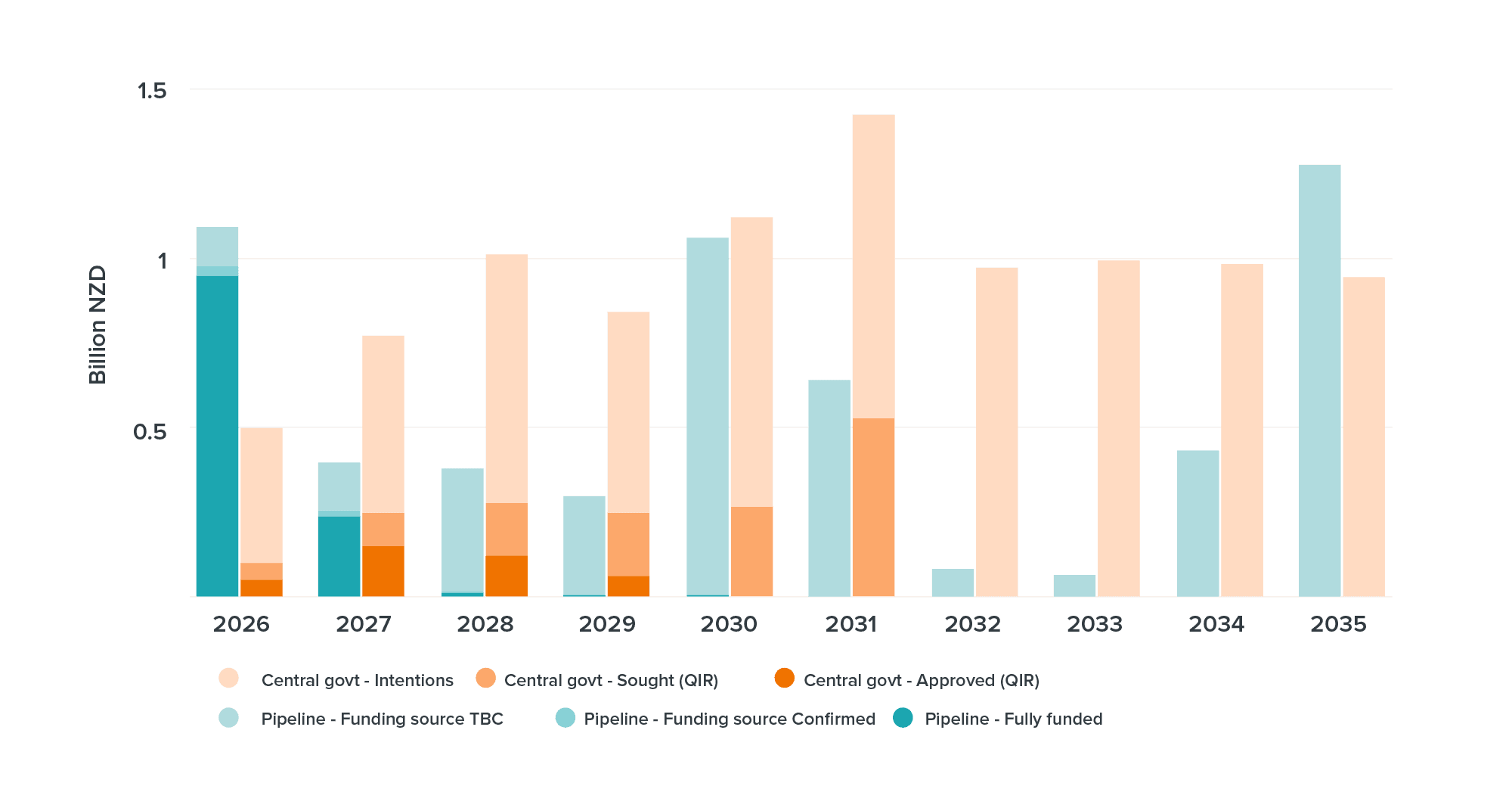
This chart compares two different measures of future investment intentions. The turquoise bars show project-level investment intentions from the National Infrastructure Pipeline, distinguishing based on funding status. The orange bars show the measure of investment intentions based on the Commission’s modelling of portfolio and programme-level data from central government’s reporting of infrastructure-specific initiatives provided to the Treasury’s Investment Management System, again distinguishing by funding status. It does not show a comparison with the Commission’s Forward Guidance on investment.
9.8. Key issues and opportunities
- Asset management: Investment to depreciation ratios over the past 20 years suggest investment levels in the sector may have been insufficient to keep pace with renewal and maintenance needs, given population and income growth also grew significantly over this period. Improved asset management and investment planning practices could yield significant benefits and certainty for the sector. Improved planning and collaboration between law and public safety agencies can provide opportunities for cost savings and operational efficiencies.
- Project appraisal, evaluation, planning and delivery: There is an opportunity for central government agencies in this sector to submit their major capital proposals to the Infrastructure Priorities Programme to ensure value for money of scare investment dollars. The various infrastructure bodies across central government, including the Infrastructure Commission, Crown Infrastructure Delivery, and National Infrastructure Funding and Financing can support agencies with all aspects of appraisal, planning, and delivery of vertical infrastructure.
- Policy certainty: Investment levels in this sector are heavily influenced by Government policy objectives. Providing the sector with certainty around law and public safety outcomes could benefit investment planning.
- Delivery in regional areas: Delivery of law and public safety services can be more difficult in rural areas where lower population density makes it difficult to justify large infrastructure investments.