Changes from the draft to final Plan
In June 2025, we published a draft of the National Infrastructure Plan. The final Plan differs from the draft Plan. While the core themes and recommendations are largely the same in the final Plan, there are changes, from minor revisions to more substantive additions.
To improve the readability of the final Plan, the document was structured around four themes:
-
Planning what we can afford
-
Looking after what we’ve got
-
Prioritising the right projects
-
Making it easier to build better.
In the draft Plan, the themes were called:
-
Establish affordable and sustainable funding
-
Start with maintenance
-
Right-size new investments
-
Clear the way for infrastructure
While the meanings are similar, we changed the wording to make the themes simpler and more memorable, and in response to specific feedback.
The final Plan was rewritten to make it more accessible. Instances of duplication in the draft were removed and sections were shortened where possible. Some content was also shifted to the website, including an explainer on how the National Infrastructure Plan relates to the 2022 National Infrastructure Strategy.
The document went through a full design process to make it attractive and easy to read, including the creation of distinct visual identities for the recommendations and priorities for the decade ahead to make them stand out.
The final Plan includes new and updated technical information. For example, our Forward Guidance forecasts showing sustainable investment levels for different infrastructure sectors changed to reflect new information from Stats NZ. The final Plan also included our first attempt to regionalise these forecasts by showing demand variations across different networks. We commissioned modelling to show changing flood risk, and updated the final Plan to include the September quarter figures for the National Infrastructure Pipeline and further lessons and endorsements from the second round of the Infrastructure Priorities Programme.
The Plan also incorporates outcomes from new technical work, including research on the relationship between infrastructure and economic growth and analysis of demand for major network capacity upgrades at a regional or project level.
We also included prominent maps showing a spatial representation of projects in our National Infrastructure Pipeline.
In the draft, Sector summaries were included in the body of the Plan. We shifted them into an appendix in the final document as they contain no specific recommendations. The final Plan expands the number of sectors from seven to 17, reflecting calls from interested stakeholders during the consultation process.
In contrast to the draft, each of the recommendations in the final Plan include a detailed implementation path, nominated lead agencies, and an indicative timeframe for actioning the proposed changes. The numbering is also different, reflecting the decision to order the document by theme. There were 19 recommendations in the draft Plan. The following four weren’t included in the final Plan, although their intent is still captured by the narrative and two sets of best practice principles:
Recommendation 3: Sustainable investment. This was removed because it was a recommendation to the Commission to regularly update our Forward Guidance and other work streams, which can be actioned internally.
Recommendation 4: Consumer protection. While there was strong support for this recommendation during the feedback period, we chose to present it as a universal set of best practice principles in the final Plan as the draft recommendation wasn’t sufficiently targeted or monitorable.
Recommendation 6: Funding pathways. This was also presented as best practice principles on how to fund and price different types of infrastructure, for example, network infrastructure should be funded from user charges. The same reason applies as for Recommendation 4.
Recommendation 15: Project transparency. There were strong levels of support for transparency measures in consultation on the draft Plan. The final Plan refers to the need for business cases and other project information to be made public, but the specific recommendation was removed because the theme of transparency cuts across multiple recommendations; it is also included in the best practice principles on aligning infrastructure providers with consumer interests.
The final Plan includes one new recommendation: ‘Predictable Government funding signals’. This complements the ‘Multi-year budgeting’ recommendation in the section on long-term asset management and investment planning and takes the total number of recommendations in the Plan to 16 – three fewer than in the draft.
In finalising the Plan, we clarified the wording of the recommendations to make them as clear and direct as possible. There were also some shifts in emphasis for several recommendations:
Recommendation 17: Learning from projects in the draft became Recommendation 10: Project information coordination in the final Plan, which was reframed around the need to have standardised, accessible project information, including post-completion details, in the National Infrastructure Pipeline.
Recommendation 10: Policy stability in the draft became Recommendation 14: Accelerated electricity investment. While the substance of this recommendation was focused on the energy sector in both the draft and the final Plan, we included more analysis to the topic in the final Plan, reflecting the importance of having accessible, affordable electricity to the wider economy. We also retitled it to clarify the purpose of the recommendation.
This addition was made in response to feedback on the draft Plan asking for more concrete, nearer-term focus areas. For the final Plan we identified 10 infrastructure priorities for the decade ahead. To do this, we drew on internal expertise, consulted with key stakeholders, and used our Forward Guidance to identify areas with particularly acute investment demand pressures.
Topics include the need to increase hospital investment to meet the needs of an ageing population, and the importance of catching up on water sector renewals and restoring affordability. The priorities each have key actions, which complement the system-level recommendations.
In making this change, we also sought to address key areas that submitters felt had not been adequately covered in the draft Plan. For example, one of the priorities focuses on identifying cost effective flood protection infrastructure. The supporting narrative is also more comprehensive, with the final Plan covering a broader range of natural hazards and threats.
Feedback on the draft Plan
We received more than 2,700 pieces of feedback on the draft National Infrastructure Plan. This came from New Zealanders and organisations across the country. There was strong agreement on the direction of the Plan, particularly the need for greater certainty, better coordination, and a stronger focus on affordability and delivery. This report summarises the feedback we received.
What we heard: Summary of feedback on the draft Plan
Download
Draft National Infrastructure Plan
Download
Submissions
Please note: personal information, offensive comments, copyrighted and/or commercially sensitive information has been redacted. Views expressed in these submissions are not those of Te Waihanga.
AA Automobile Association
Download
ACE New Zealand
Download
Air New Zealand
Download
Amuri Net Limited
Download
Āpōpō
Download
Architecture, Engineering and Construction (AEC) Working Group, part of the AI Forum of New Zealand
Download
Asset BowManagement Ltd
Download
Association of Salaried Medical Specialists
Download
Auckland Airport
Download
Australasian Railway Association
Download
Bay of Plenty Regional Council
Download
beforeUdig
Download
Bus and Coach Association New Zealand
Download
Business New Zealand
Download
Campaign for Better Transport Incorporated
Download
Canterbury Mayoral Forum
Download
CEDA (Central Economic Development Agency)
Download
Central Government AM Leaders Forum
Download
Chorus
Download
Christchurch City Council
Download
Civil Contractors New Zealand
Download
Concrete NZ
Download
Consultus Ltd
Download
Crown Infrastructure Delivery (CID) Limited
Download
Department of Conservation
Download
Enable Fibre Networks
Download
Energy Resources Aotearoa
Download
Engineering NZ
Download
Environment Canterbury
Download
Environment Southland
Download
Fonterra
Download
Hamilton City Council (staff feedback)
Download
Hawkes Bay Regional Council
Download
Horizons Regional Council
Download
Hotel Council Aotearoa
Download
Infrastructure New Zealand
Download
Infrastructure Sustainability Council
Download
Institute of Public Works Engineering Australasia
Download
Institution of Chemical Engineers NZ
Download
Insurance Council of New Zealand
Download
Internet NZ
Download
Irrigation NZ
Download
Islands for the Future of Humanity
Download
Manawatū District Council
Download
Maritime Union of New Zealand
Download
Master Builders Association of NZ
Download
Meridian Energy Ltd
Download
Ministry of Education
Download
Ministry of Justice
Download
National Emergency Management Agency (NEMA)
Download
National Road Carriers
Download
Natural Hazards Commission Toka Tū Ake
Download
New Zealand Council of Trade Unions Te Kauae Kaimahi
Download
New Zealand Government Procurement
Download
New Zealand Rivers Group
Download
New Zealand Telecommunications Forum (TCF)
Download
New Zealand Airports Association
Download
Northern Infrastructure Forum
Download
Northland Regional Council
Download
Office of ECE
Download
Orion New Zealand Limited
Download
Otago and Southland Regional Transport Committees
Download
Palmerston North City Council
Download
Porirua City Council
Download
Powerco
Download
Property Council New Zealand
Download
Raukawa Charitable Trust
Download
Reflective Construction Law
Download
Rewiring Aotearoa
Download
Rosebank Business Association
Download
Royal Institution of Chartered Surveyors (RICS)
Download
Selwyn District Council
Download
South Island Regional Transport Committee Chairs Group
Download
Sport NZ
Download
Taituarā - Local Government Professionals Aotearoa
Download
Te Uru Kahika
Download
Te Utanganui
Download
The Aggregate and Quarry Association
Download
The Connectivity Group Limited (TCG)
Download
The Future is Rail
Download
The Internet Service Providers Association of New Zealand Inc (ISPANZ)
Download
Tourism Industry Aotearoa
Download
Transportation Group
Download
Tuatahi First Fibre
Download
Unison Networks Limited
Download
Upper Hutt City Council
Download
Urban Task Force
Download
Vector Limited
Download
Waikato Regional Council
Download
Waimakariri District Council Staff
Download
WasteMINZ
Download
Watercare
Download
Water New Zealand
Download
Wellington City Council (Staff Feedback)
Download
Western Bay of Plenty District Council
Download
Zero Waste Aotearoa
Download
Individual submission 1
Download
Individual submission 2
Download
Individual submission 3
Download
Individual submission 4
Download
Individual submission 5
Download
Individual submission 6
Download
Individual submission 7
Download
Individual submission 8
Download
Individual submission 9
Download
Individual submission 10
Download
Individual submission 11
Download
Individual submission 12
Download
Individual submission 13
Download
Individual submission 14
Download
Māori engagement
This report presents insights gathered through engagement with iwi and rōpū Māori. While it does not claim to represent all iwi/ Māori rōpū voices, it reflects the whakaaro (thoughts, ideas, opinions and perspectives) of those who participated, providing an indication of the directions they see as critical for the future of infrastructure in Aotearoa New Zealand.
Aurecon was engaged to produce this report.
Māori in infrastructure engagement insights report
Download
Discussion document
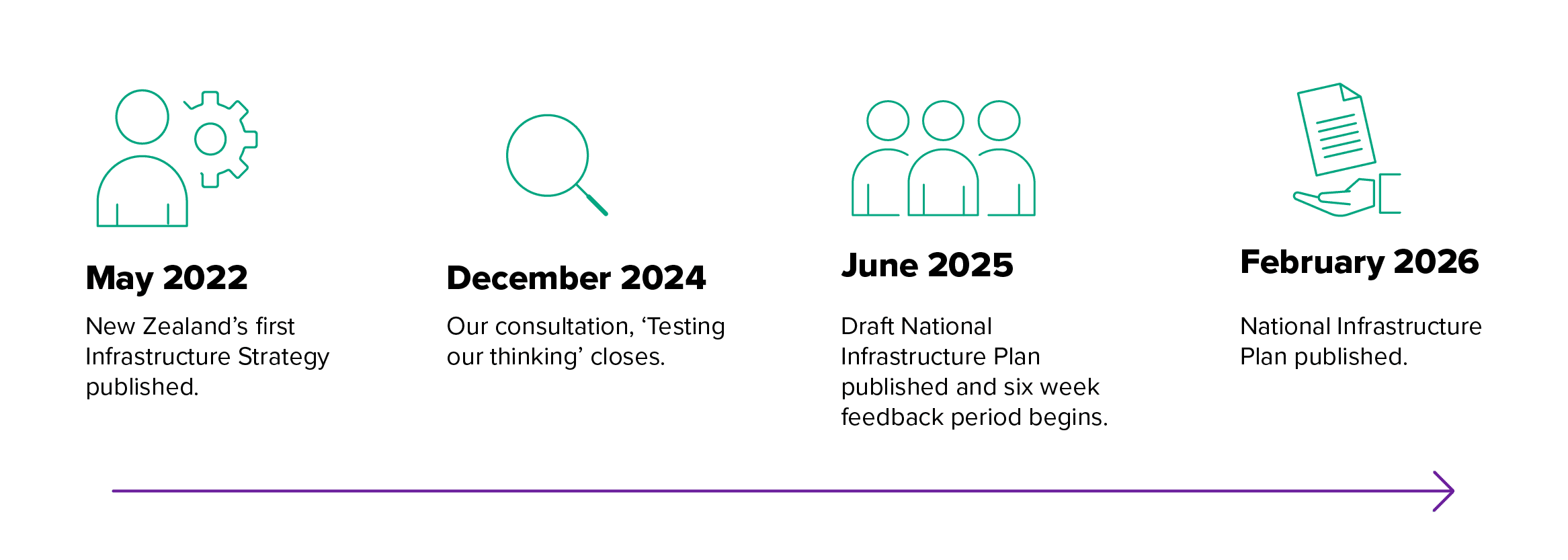
In 2024 we asked for feedback on a discussion document, Testing our thinking, that described what we expected a National Infrastructure Plan will cover and the problem it’s trying to solve, as well as the approach we proposed to take to develop it.
The document provided stakeholders an early opportunity to engage and shape the development of the Plan, identify additional challenges and opportunities, and build a shared understanding of priorities and trade-offs.
Testing our thinking: Developing an enduring National Infrastructure Plan
Download
Summary of feedback we received on Discussion document
Download
Submissions
A range of organisations and individuals submitted in response to the discussion document.
Please note: personal information, offensive comments, copyrighted and/or commercially sensitive information has been redacted. Views expressed in these submissions are not those of Te Waihanga.
ACE New Zealand
Download
Adapt Research Ltd
Download
Aggregate and Quarry Association of New Zealand
Download
Air New Zealand
Download
AMSAAM Ltd
Download
Āpōpō
Download
ASB Bank Ltd
Download
Auckland Airport Ltd
Download
Aurecon New Zealand Ltd
Download
BECA Ltd
Download
Business New Zealand
Download
Christchurch City Council (staff submission)
Download
Clarus
Download
ConCOVE Tūhura
Download
Concrete New Zealand Inc
Download
Connexa Ltd
Download
Department of Internal Affairs
Download
Downer New Zealand Ltd
Download
Electricity Engineers Association of New Zealand
Download
Electricity Networks Aotearoa
Download
Enable Networks Ltd
Download
Energy Resources Aotearoa Inc
Download
Engineering New Zealand
Download
Flightplan2050 Incorporated
Download
Fonterra Limited
Download
Forest & Bird New Zealand
Download
Globaltraid Limited
Download
Government Chief Digital Office
Download
Guardians of New Zealand Superannuation
Download
Hamilton City Council
Download
Higgins Family Holdings Limited
Download
Infrastructure New Zealand
Download
Infrastructure Sustainability Council
Download
Irrigation New Zealand Incorporated
Download
Islands for the Future of Humanity
Download
Local Government New Zealand
Download
Mercury NZ Limited
Download
Ministry of Business, Innovation and Employment
Download
National Emergency Management Agency (NEMA)
Download
Natural Hazards Commission
Download
Nelson Regional Development Agency Limited
Download
New Zealand Aged Care Association Incorporated
Download
New Zealand Defence Force
Download
New Zealand Geotechnical Society Incorporated
Download
New Zealand Planning Institute Incorporated
Download
New Zealand Recreation Association Incorporated
Download
New Zealand Telecommunications Forum
Download
New Zealand Utilities Advisory Group
Download
NZ Airports Association Incorporated
Download
NZTech
Download
NZ Transport Agency Waka Kotahi
Download
Office of the Parliamentary Commissioner for the Environment
Download
Orion New Zealand Limited
Download
Otago Regional Council
Download
Packaging Council of New Zealand
Download
Positive Money New Zealand Incorporated
Download
Powerco Limited
Download
Property Council of New Zealand
Download
Public Service Commission
Download
Queenstown-Lakes District Council
Download
Raukawa Charitable Trust
Download
Reflective Construction Law
Download
Rewiring Aotearoa
Download
Richard Mowll Consulting Limited
Download
Rubix Limited
Download
Sport New Zealand
Download
Straterra
Download
Taituarā Charitable Trust
Download
Tauranga City Council
Download
The New Zealand Initiative
Download
Transpower New Zealand Limited
Download
Tuatahi First Fibre Limited
Download
Urban Development Institute of New Zealand
Download
Vector Limited
Download
Waikato Regional Council
Download
Waste Management NZ Limited
Download
Water New Zealand Ltd
Download
WSP New Zealand Ltd
Download
Individual submission 1
Download
Individual submission 2
Download
Individual submission 3
Download
Individual submission 4
Download
Individual submission 5
Download
Individual submission 6
Download
Individual submission 7
Download
Individual submission 8
Download
Individual submission 9
Download
Individual submission 10
Download
Individual submission 11
Download
Individual submission 12
Download
Individual submission 13
Download
Individual submission 14
Download
Individual submission 15
Download
Individual submission 16
Download
Individual submission 17
Download
Individual submission 18
Download
Individual submission 19
Download
Individual submission 20
Download
Individual submission 21
Download
Individual submission 22
Download
Individual submission 23
Download
National Infrastructure Plan
The National Infrastructure Plan sets out a 30-year pathway for improving how New Zealand plans and delivers infrastructure.