Content
Content

Corrections
10.1. Institutional structure
Service delivery responsibilities
- The Department of Corrections (Ara Poutama Aotearoa) manages New Zealand's 18 adult prisons. These facilities are categorised by security level and whether they house male or female prisoners. There are 15 prisons for male offenders located throughout the North and South Islands and three prisons for female offenders, situated in Auckland, Wellington, and Christchurch.
- As part of its remit, Corrections also has responsibility for probation services and community sentences provided by a network of over 100 Community Corrections Sites across the country. Most of these community sites are leased, but they feature substantive fit-outs that meet Correction’s standards for safety and security of staff and clients.
- Beyond the adult prison system, there are also five youth justice residences. These are secure facilities for young offenders and are managed by Oranga Tamariki, the Ministry for Children.
Governance and oversight
- The Ministry of Justice is the lead agency for the justice sector, responsible for justice policy and oversight of Corrections and Police. It also chairs the Justice Sector Leadership Board (JSLB) to coordinate with other justice sector agencies, of which both Police and Corrections are members.
- The Department of Corrections is accountable to the Minister of Corrections. Independent oversight is provided by the Office of the Ombudsman, and the Inspector of Corrections, which handle complaints and conduct investigations.
10.2. Paying for investment
- Corrections receives annual parliamentary appropriations that are funded through general taxation. These appropriations include both capital and operating expenditure. Significant projects that require large amounts of capital are subject to a separate business case and Budget bid process.
- From time to time, New Zealand has used public-private partnerships (PPPs) for major prison infrastructure projects, including Auckland South Corrections Facility (Wiri), Waikeria Prison expansion, and part of Auckland Men’s Prison. Auckland South Corrections Facility is unique in that it is fully managed by the PPP, both in terms of correctional service delivery and infrastructure. Phase 1 of the Christchurch Men’s Prison redevelopment is expected to be delivered under a revised infrastructure-only PPP model, similar to the one in place at Auckland Men’s and Waikeria. The use of PPPs has sometimes had mixed results for prisons. For example, the Mount Eden Prison PPP, which delivered both infrastructure and correctional services, ended earlier than expected due to perceived contractual difficulties.
10.3. Historical investment drivers
- Corrections infrastructure is tied to population-driven demands, as a larger population will require greater capacity to process offenders. However, policy decisions around sentencing and managing of court backlogs have a larger impact on the requirements for prison capacity. Other general drivers of prison infrastructure include changing levels of service (for example, single bunking relative to double bunking) and improving standards within prisons based on human rights conventions.
- A significant driver for investment in the corrections sector has been the rising prison population, which has led to periods of time where overcrowding pointed to the need for new facilities and capacity expansions. However, there have also been periods of low incarceration levels which underpinned a rationalisation of the prison stock. This has led to undercapacity followed by overcapacity under differing policy regimes, making forecasting at the sector level challenging. The Commission’s analysis indicates past forecasts of prison population have on average over-estimated capacity requirements, while volatility in the forecast errors means a combination of over-shooting and under-shooting population numbers makes it difficult to plan network capacity.204
- The prison population can be broadly divided into two groups: prisoners sentenced of a crime and serving their imposed time, and remand prisoners. Remand prisoners are either accused (presumed innocent and held before trial) or convicted (awaiting sentencing following a conviction). The share of prisoners who are on remand has been broadly increasing over time (currently around 40%), creating operational challenges and pressure to provide more high security ‘beds’. Remand prisoners need to be separated from the sentenced prison population, and are often managed as a high security risk on arrival by default – a practice dating to a time when remand was used rarely and only for people accused of the most serious offences.
10.4. Community perceptions and expectations
This section summarises what we know about the New Zealand public’s perceptions and expectations of the corrections sector, at a national level.
- New Zealanders views on the need for prisons are mixed. One study showed that almost 60% of New Zealanders agree that in the future we will use prisons less than now, or about the same, while only 16% agree that we will use prisons ‘a little bit more’ than we currently do.205 A different study showed that about half of New Zealanders currently believe that spending on new prisons is necessary to some extent.206
10.5. Current state of network
- The total fair value of Corrections’ property, plant and equipment (PP&E) assets (excluding land value) was $4.8 billion as of 30 June 2025,207 making it one of the largest infrastructure sectors within public administration and safety.
- The value of the capital stock increased rapidly in the early 2000s as capital investment averaged over $600 million per year from 2005 through to 2008. This corresponds to the opening of four prisons, expanding total spaces by over 2,500 inmates. Since that period, investment has been more muted, with the exception of the new 596-bed Waikeria Prison, which was completed in April 2025 and valued at $792.6 million for its PPP-related PP&E assets in the agency’s annual report.208 Since 2023, plans to meet an increasing prison population have included a further 810-bed expansion at Waikeria and 240 additional beds at Christchurch Men’s Prison.
- Overall, asset condition is trending downwards within Corrections, with higher levels of investment in renewals and maintenance of existing stock required in future to maintain levels of service, in addition to the significant capital investment planned in new-builds to meet growing demand.
- Corrections is not currently meeting its own levels of service targets for prison asset condition, with 10% of prison asset value being held in poor/very poor condition; 6% above a maximum 4% target. It is also only achieving 81% of prison asset value in good/very good condition, against a target of no less than 85%. The percentage of owned Community Corrections Site asset value with a poor/very poor condition also rose from 2% to 5% in 2024, against the target of no more than 4%.209
- We can observe the extent to which total investment (including renewals as well as improvements) is keeping up with depreciation.(Note: If investment falls below depreciation, this implies assets are being ‘sweated out’. However, even if investment is above depreciation, if that investment is directed to new infrastructure, it is still possible that existing assets are deteriorating at the expense of new infrastructure. In the absence of knowing renewal investment to depreciation specifically, the higher the ratio the better the overall condition of the asset base.) Investment to depreciation ratios for Corrections exceeded 200% over the last 25 years. This would indicate, overall, that the quality of Corrections assets has improved over this time period. However, deferred maintenance and renewal liabilities exist across the older facilities.
10.6. Forward Guidance for capital investment
Forward Guidance for Corrections infrastructure investment

Note: Ranges are based upon each subsector’s estimated relative share of the total public safety category over the past 10 to 20 years. These shares are derived from the estimated share of capital stock and investment over the period. Data on asset values and investment collected by the Commission from agency annual reports.
- Our Forward Guidance for Corrections investment projects a need for additional investment relative to recent years, primarily because of the need to renew and maintain the recent expansion of the prison network, as well as covering the cost to maintain and renew older facilities and infrastructure.
- Forecasting Corrections' demands is very challenging because demand is largely driven by policy choices by the Government of the day. The Department of Corrections makes forecasts for future prisoner populations, but they have proven relatively inaccurate because of policy uncertainty. However, it should be possible to produce a baseline forecast for maintenance and renewals costs across the lifecycle of existing assets.
10.7. Current investment intentions
- As one of the largest estates within the government’s property and asset portfolio, Corrections develops and manages a complex set of facilities that incarcerate and rehabilitate a growing prison population. Corrections uses the Long-Term Network Configuration Plan (LTNCP) to balance the evolution of the prison network over time, including the security mix across facilities and regional capacity requirements. Under the current LTNCP the aim is to retire 2,200 prison beds that are no longer fit for purpose and create 5,100 new (mostly high security) beds across the network, for a net gain of 2,900 beds over the next two decades.
- The Government's current justice policies include increased resourcing for police and longer sentences, especially for three strikes violent and sexual offences. This approach requires increases in operational funding across justice sector operations, but also complementary infrastructure investment to support the expected increase in prisoner volumes.
- The new 596-bed facility at Waikeria is now open and receiving prisoners. The Government intends to build another 810-bed facility on the site, the first phase of the Christchurch Men’s Prison redevelopment has also been announced (240 beds) and there is a possible future development at Auckland Men’s Prison (Paremoremo).
- For Corrections, our Forward Guidance is long-term indicative guidance, rather than an annual projection. As such, we have excluded it from the chart below.
Figure 55: Corrections investment intentions
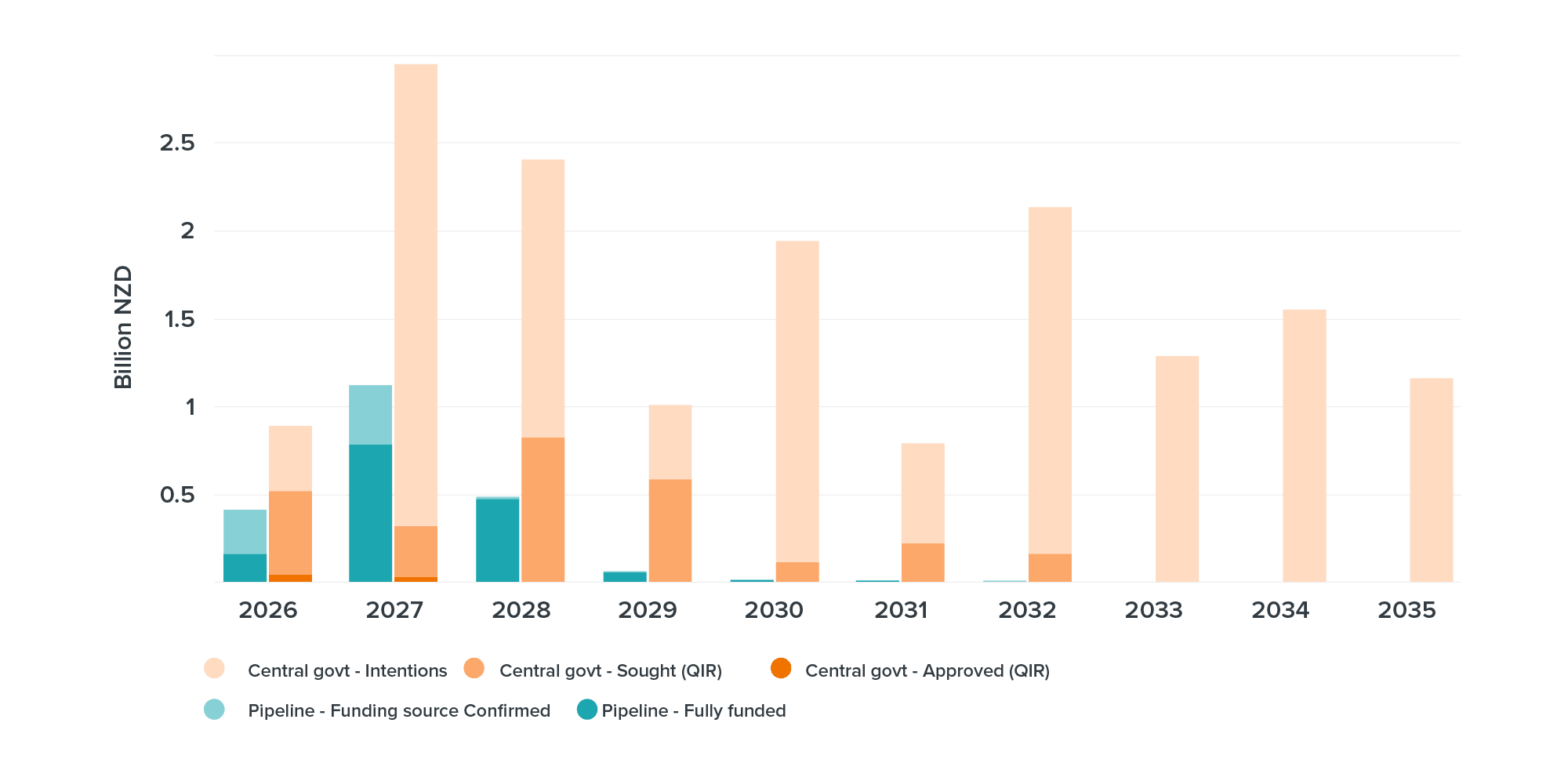
This chart compares two different measures of future investment. The turquoise bars show project-level investment intentions from the National Infrastructure Pipeline, distinguishing based on funding status. The orange bars show the measure of investment intentions from central government’s reporting of infrastructure-specific initiatives provided to the Treasury’s Investment Management System, again distinguishing by funding status. Note that intentions data reflects the date that the funds will be required, not the dates that the related spend takes place. It does not show a comparison with the Commission’s Forward Guidance on investment demand.
10.8. Key issues and opportunities
- Policy and prison population patterns: Challenges include managing a large remand population relative to the sentenced prison population, which puts pressure on the corrections system, addressing the high proportion of Māori in the justice system, and funding the significant cost of upgrading an ageing infrastructure portfolio. The larger remand population and longer sentences for convicted offenders does create forecasting challenges for prison capacity – not just on an overall basis, but also the forecast capacity requirements across high, medium and low security areas.
- Investing in the face of uncertainty: Corrections faces significant uncertainty about the level and composition of the remand and prison populations at a national and regional level. Measuring crime is difficult and measures have changed over time. Subject to this caveat, the New Zealand Crime and Victimisation Survey finds broadly stable rates of crime and victimisation over time. In contrast, the use of incarceration in response to crime has changed significantly over time, reflecting different public and political views about the response. Investing in infrastructure that can more efficiently be expanded or adjusted to different security levels is one way of managing this uncertainty.
- Different models of delivery: Exploring alternative models of infrastructure provision, including partnerships with iwi and community housing providers, already offers Corrections innovative solutions for delivering reintegration and rehabilitation services.