We need to fix the leaks, not just keep buying bigger mops.Helmut Modlik - Tumu Whakarae, Te Rūnanga o Toa Rangatira
Content
Content
1. Finding common ground: The context for long-term infrastructure decisions
Te kimi āhuatanga ōrite: Te horopaki mō ngā whakataunga tūāhanga tauroa
Summary
- Infrastructure supports our wellbeing, drives productivity and economic growth, and helps achieve broader social and environmental goals. But these benefits come with significant and lasting costs, and investment decisions are often irreversible, so they need to be future-focused and grounded in clear long-term need.
- A range of public and private organisations are involved in providing New Zealand’s infrastructure. Public owners tend to balance multiple outcomes (such as health, education and mobility), while private and corporate owners largely focus on achieving commercial returns and maintaining the value and performance of their assets. Effective economic regulation of commercial providers fosters better asset management and investment practices.
- Maintaining and renewing existing assets is our greatest investment challenge. It should account for as much as 60 cents in every $1 of capital spending, reflecting the scale and age of our networks.
- Looking after what we’ve got is made more challenging by infrastructure-damaging natural hazard events, like earthquakes and extreme weather, and malicious threats like cybersecurity breaches that make infrastructure harder to operate and more costly to insure.
- We also need to keep building new and improved infrastructure in response to our growing population, changing demographics, technological shifts and the need to decarbonise the economy.
- New Zealanders pay for infrastructure in three main ways: user charges, local government rates and central government taxation. Households face tightening affordability constraints as costs rise and the population ages.
- Despite high levels of spending, New Zealand often struggles to get value for money from its infrastructure investments. Underlying drivers of poor value include fragmented planning, regulatory inefficiencies, complex approval processes and suboptimal use of existing assets.
- Fiscal pressures on both central and local government mean future investment will need to be more targeted, efficient and prioritised.
Infrastructure is about services
Infrastructure is a means to an end. We build water pipes to move water to people who need it. We build swales and wetlands to protect our properties against flooding. We build new roads and other networks to service the new subdivisions providing warm, safe housing. It isn’t the concrete and steel we value, but what infrastructure allows us to do – how it connects us and improves our lives.
Our economy depends on interdependent infrastructure services. We commute on transport networks built and maintained by generations of New Zealanders. These networks open up land for housing and business, connect communities to jobs and services, and link producers to the ports that connect us to global markets. Roads and rail lines move the goods that fill our supermarket shelves. And those supermarkets, in turn, rely on electricity generated by power stations – many built decades ago – to keep the lights on and food chilled.
Infrastructure also supports wider social and environmental goals. The 2022 New Zealand Infrastructure Strategy, which this Plan builds on, outlines a vision where our infrastructure drives higher living standards, contributes to a strong economy, enables our culture and society to thrive, and integrates into and supports te taiao, the natural world. The recommendations in the Strategy, Rautaki Hanganga o Aotearoa, remain relevant (see Appendix Two). During the development of this Plan, we heard from New Zealanders about the importance of taking an intergenerational, inclusive approach to planning and delivering new infrastructure.
We rely on many types of infrastructure
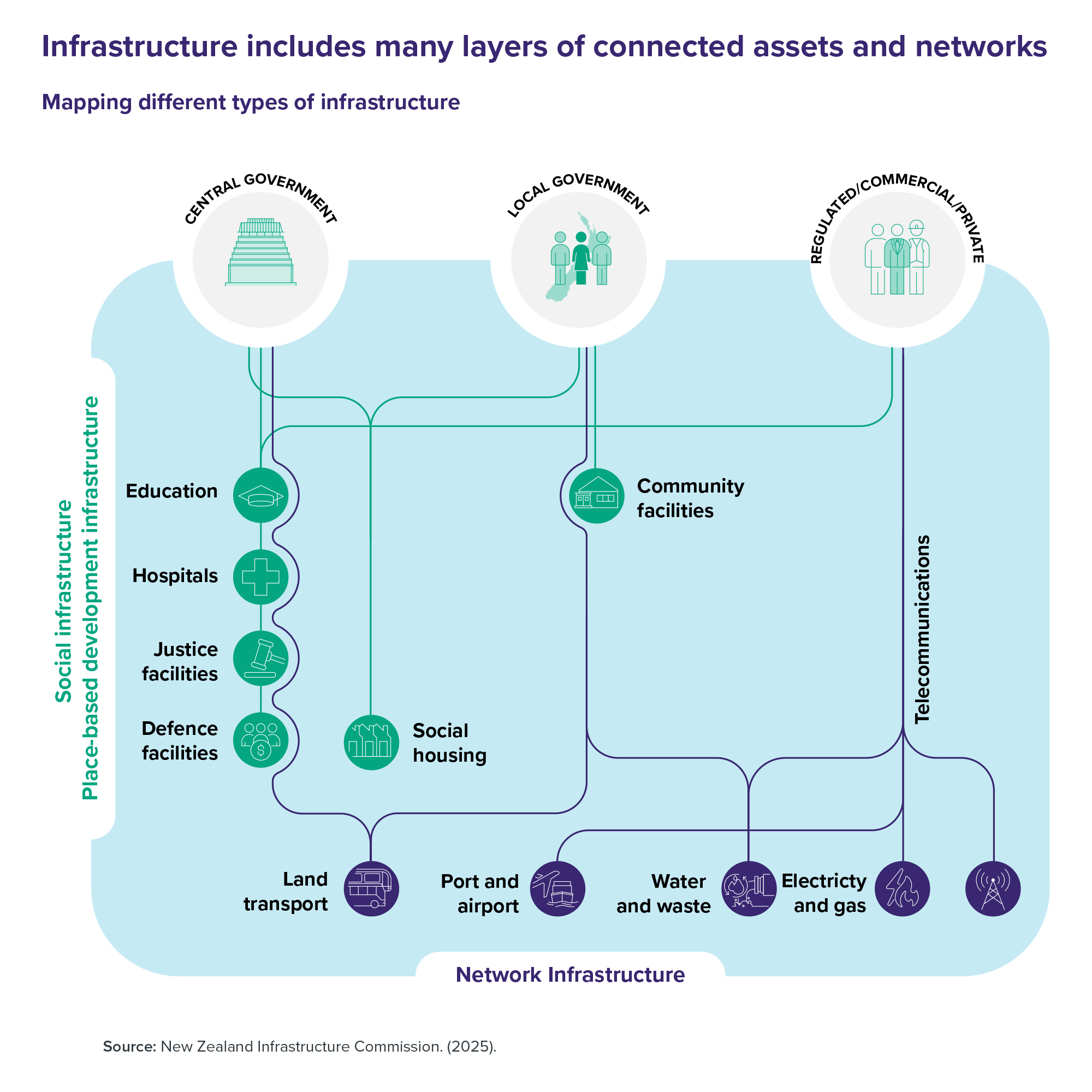
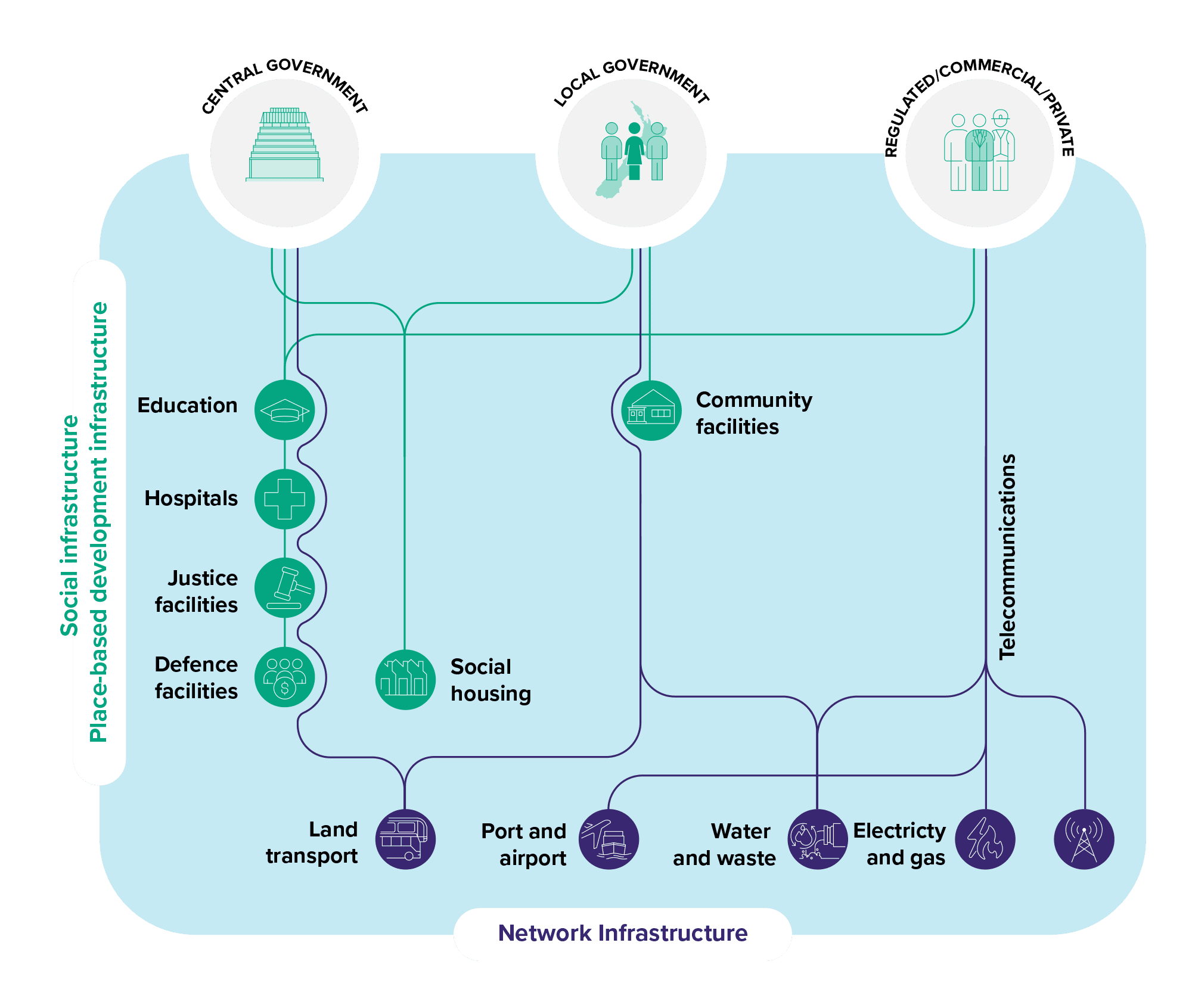
There are many types of infrastructure (Figure 2). When we say ‘infrastructure’, we mean the networks that provide our water and wastewater, internet, electricity and transport choices. The term also includes social infrastructure, like hospitals, schools and courts. Infrastructure can also include things like public parks and green spaces (which help with urban stormwater management), household solar panels and batteries (which are an alternative to grid-connected electricity supply) and community and spiritual hubs such as marae. It can also include place-based development infrastructure intended to boost economic activity, like convention centres or business incubators.
Infrastructure includes many layers of connected assets and networks
Figure 2: Mapping different types of infrastructure
Source: New Zealand Infrastructure Commission. (2025).
Many organisations are involved in providing New Zealand’s infrastructure (Figure 2). The infrastructure sector includes a complex ‘alphabet soup’ of government agencies, local government entities, regulated utilities, state-owned enterprises, council-controlled organisations, and commercial businesses like airports and ports. Infrastructure providers have a variety of governance, decision-making processes and funding models. As an autonomous Crown entity, the Commission advises the Government of the day on how the infrastructure system is performing. Other government infrastructure agencies include Crown Infrastructure Delivery, which assists other agencies with project management and delivery, and National Infrastructure Funding and Financing, a Crown-owned company established to connect private capital with public infrastructure projects.
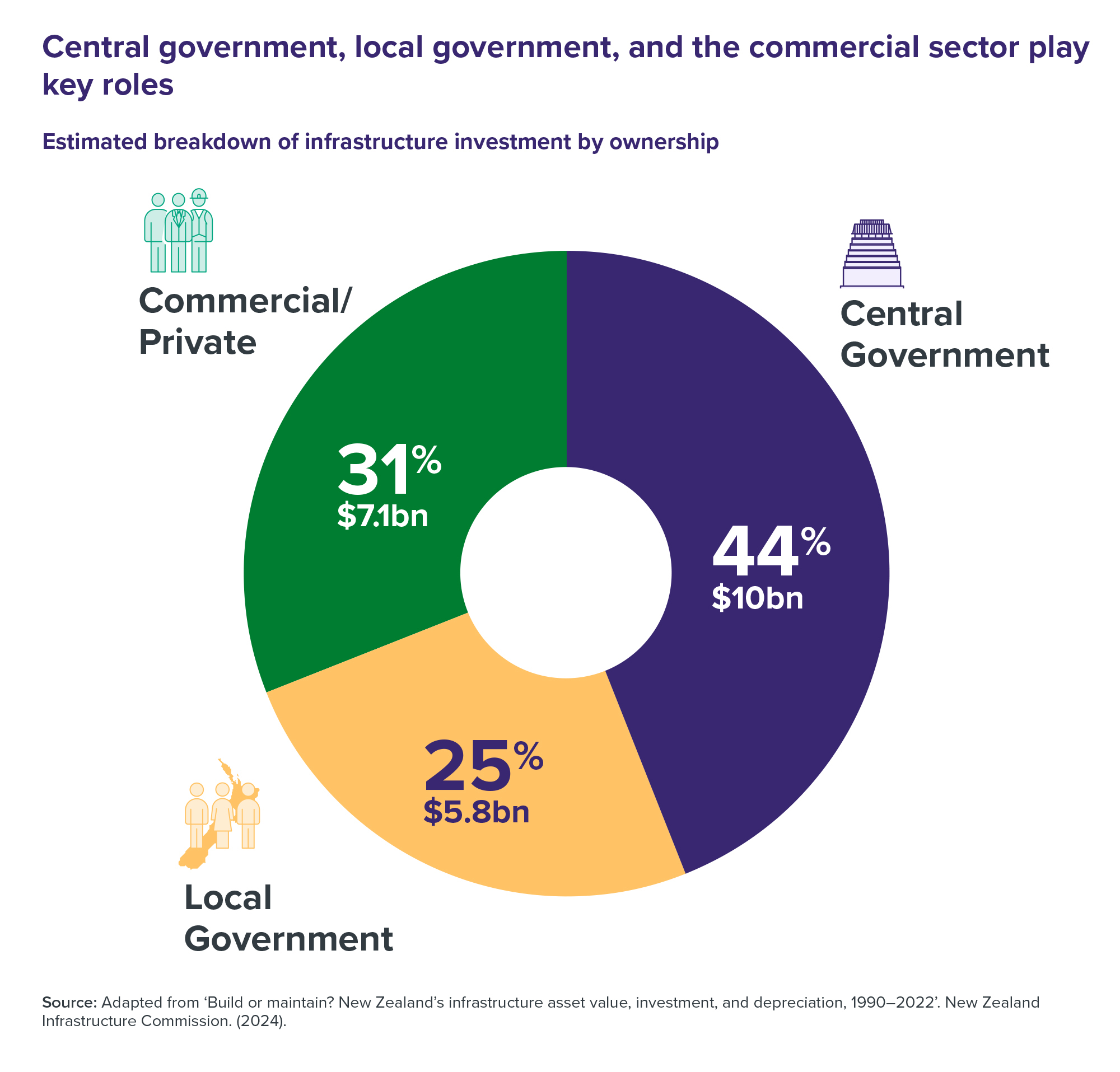
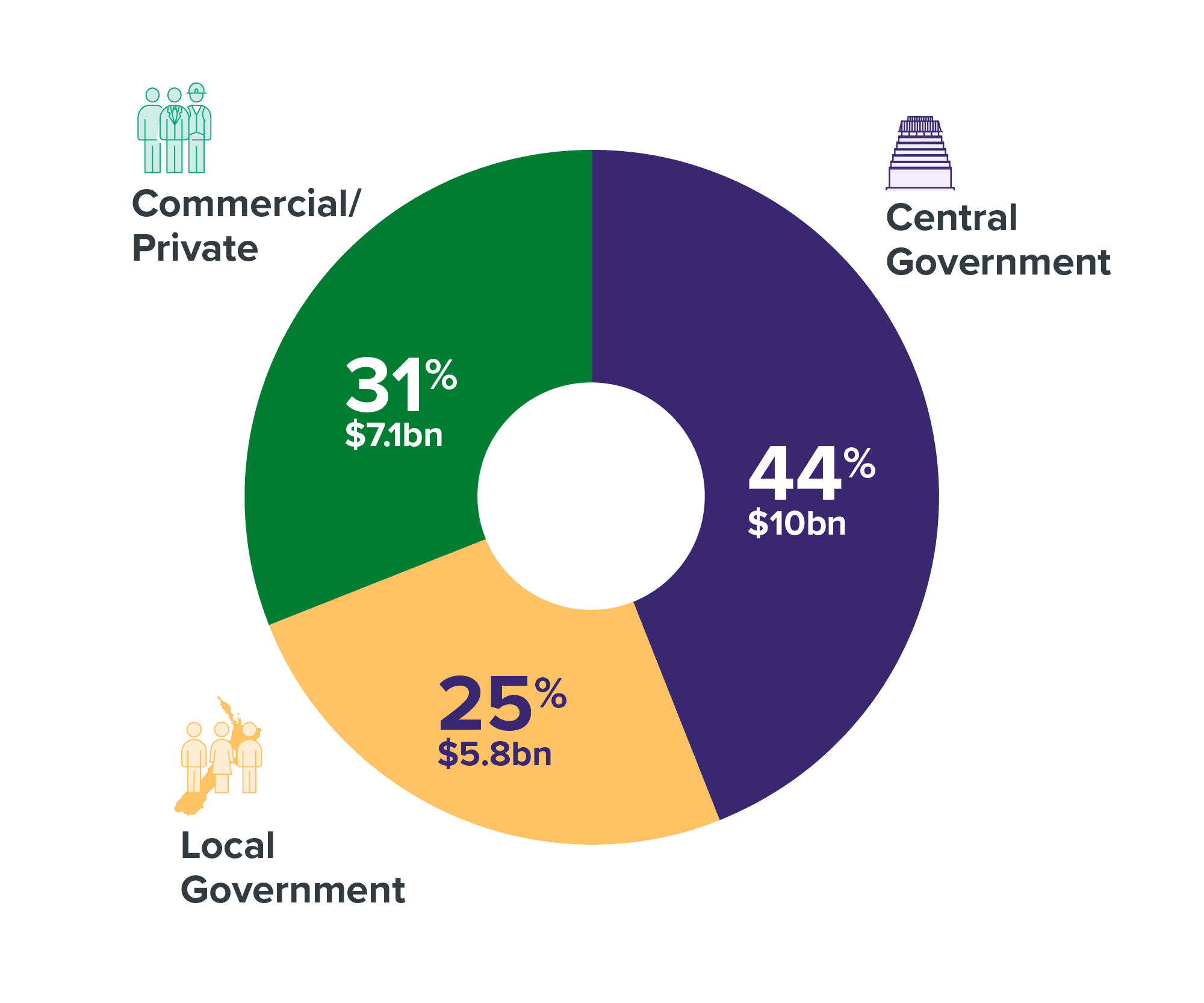
There’s a role for everyone. Local government and commercial entities are responsible for over half of New Zealand’s infrastructure investment (Figure 3). A largely private sector workforce of over 100,000 people is involved in designing and building new infrastructure and maintaining it once we’ve got it.6 Iwi and Māori entities are involved in infrastructure as investors, asset owners, and suppliers.
To get it right, we need the public sector to step up. Central government is New Zealand’s largest owner and funder of infrastructure. It accounts for 45% of our total stock of infrastructure and almost half of all infrastructure investment each year.7 Central government also sets the ‘rules of the game’ for other sectors – including the oversight and governance arrangements that shape how local government and commercial entities operate. For example, the Commerce Commission regulates monopoly providers of commercial infrastructure that is funded from user revenues.
Central government’s approach to building and maintaining its infrastructure stands out. Unlike local government and commercial entities, central government oversees its own performance through the Investment Management System, which is a part of the overall Public Finance System. But while it sets rules for itself, it doesn’t always live by those rules. Around half of all proposals for investment in the last three Budgets did not have complete business cases. Half of all capital-intensive agencies have self-reported that they do not have robust, comprehensive asset registers in place or adequate plans for looking after existing infrastructure.
The Māori-Crown relationship plays an important and evolving role in infrastructure.Te Tiriti o Waitangi/The Treaty of Waitangi (the Treaty) underpins this relationship, which should give effect to trust-based partnerships between government infrastructure providers and iwi. Exercising their role as kaitiaki, iwi are also becoming increasingly active as infrastructure investors and developers.
There is ongoing discussion regarding what the Treaty requires for infrastructure projects. But there appears to be consensus between mana whenua groups, the New Zealand courts and infrastructure providers that it obliges both Māori groups and government infrastructure providers to:
-
act reasonably, honourably and in good faith, and be genuine, collaborative, and respectful
-
listen to what others have to say, consider those responses and then decide what will be done.
Early, enduring partnerships are important for good outcomes. This includes working with iwi and other Māori groups to build capability before it's needed, providing clarity of roles early, making project information accessible to Māori groups, and recognising Māori mātauranga (knowledge) as a factor that can add value to projects.
Central government, local government, and the commercial sector play key roles
Figure 3: Estimated breakdown of infrastructure investment by ownership
Source: Adapted from ‘Build or maintain? New Zealand’s infrastructure asset value, investment, and depreciation, 1990–2022’. New Zealand Infrastructure Commission. (2024).
New Zealand spends a lot but doesn’t always get value
Infrastructure is not free – someone has to pay for it. There are upfront costs for new assets, as well as ongoing costs to maintain, renew, replace and occasionally decommission things like roads and pipes. We fund infrastructure through three main sources: user charges, local government rates, and central government taxes. Financing (or ‘when we pay’) can spread out the cost of new assets over time, but one way or another, the cost is ultimately borne by New Zealanders.
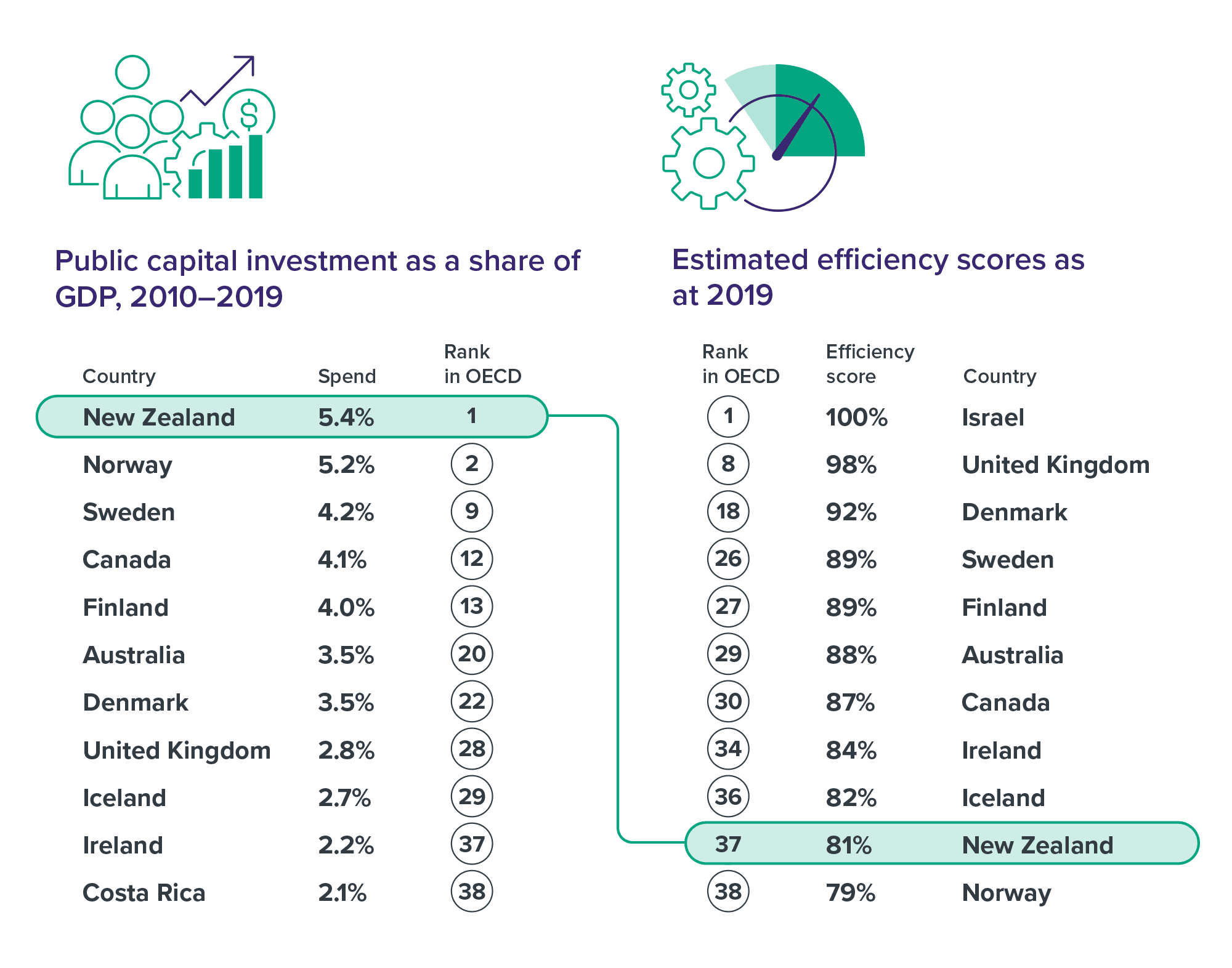
New Zealand spends more than most on infrastructure. Over the last 20 years, New Zealand spent an average of 5.8% of GDP per year on infrastructure, putting us towards the upper end of OECD countries.8 In 2022, we spent almost $5,000 for every person in the country (in 2025 NZD).9
We don’t get enough for our infrastructure dollar. The quality of our infrastructure lags relative to what we spend on it. High-level comparisons suggest we get relatively poor ‘bang for buck’ for our spend, meaning fewer kilometres of road, rail or pipe per dollar than many other countries (Figure 4).10
New Zealand has a small population spread over a large and geologically challenging land area. We have a similar population to Greater Sydney, but our 5.3 million people are spread over an area around 21 times larger.11 Because we don’t have as many people in any given area, we can’t always afford to build infrastructure to the same standard as more densely populated countries.
But we also make things difficult for ourselves. Compared to other high-income countries, it’s costly to build complex public infrastructure projects in New Zealand.12 We sometimes make premature decisions about projects, leading to cost overruns. We also make it difficult to make the best use of our existing assets. For instance, the lack of time-of-use charging means we build city motorway networks to cater for peak demand; rigid land-use rules prevent apartments being built around rapid transit lines; and the absence of water metering means we’re not getting as much value out of our existing infrastructure as we could.
Our regulatory system is complex. We have 1,175 land-use zones across 67 territorial authorities. Japan – which has more than 20 times the population of New Zealand – has 13. We spend $1.3 billion every year just on consenting infrastructure and the cost of managing traffic during construction has surged in recent times.
In future, renewing and maintaining existing assets will be our greatest investment challenge. Many of the buildings and infrastructure networks built in New Zealand after the Second World War are now wearing out. Rebuilding or replacing these assets will take up as much as 60 cents in in every dollar of new infrastructure investment, reflecting how much infrastructure we already have. 13 Protecting existing assets from natural hazard events and other threats will also drive investment. Climate change will increase the cost and frequency of some natural hazard events, like flooding and extreme weather. Insuring infrastructure against natural hazard events and other risks is also getting more costly, further constraining budget choices.
New capital investment will also be necessary. New Zealand needs to keep building and improving infrastructure in response to its growing and ageing population, economic growth and international trade, technology changes, and the need to provide affordable and reliable electricity to decarbonise the economy. But these trends will impact some sectors differently than others. As our population ages, for instance, we are likely to need relatively more hospitals and healthcare services, and relatively fewer new classrooms in schools.
The future is uncertain. New technologies such as artificial intelligence could fundamentally change how people use infrastructure. We may be forced to borrow more to build back after an earthquake or another unpredictable event. Population and productivity growth could be faster or slower than predicted, affecting both how much new infrastructure we need and how easy it will be to pay for it. Often, these uncertainties add to infrastructure costs, although we can take actions to mitigate some of these costs.
New Zealand spent more on public infrastructure as a share of GDP than any other OECD country in the 2010s, but infrastructure quality doesn’t measure up to what we spend
Figure 4: Public capital investment and investment efficiency scores for selected OECD countries
Note: ‘Public capital investment’ refers to investment by central government and subnational governments, including some non-infrastructure investment, but excludes investment by private infrastructure providers. As a result, it is close to, but not the same as, more comprehensive measures of infrastructure investment that we have for New Zealand. Source: Adapted from ‘Investment gap or efficiency gap? Benchmarking New Zealand’s investment in infrastructure’. New Zealand Infrastructure Commission. (2021). Data sourced from the International Monetary Fund.
An ageing population and poor productivity mean money’s getting tighter
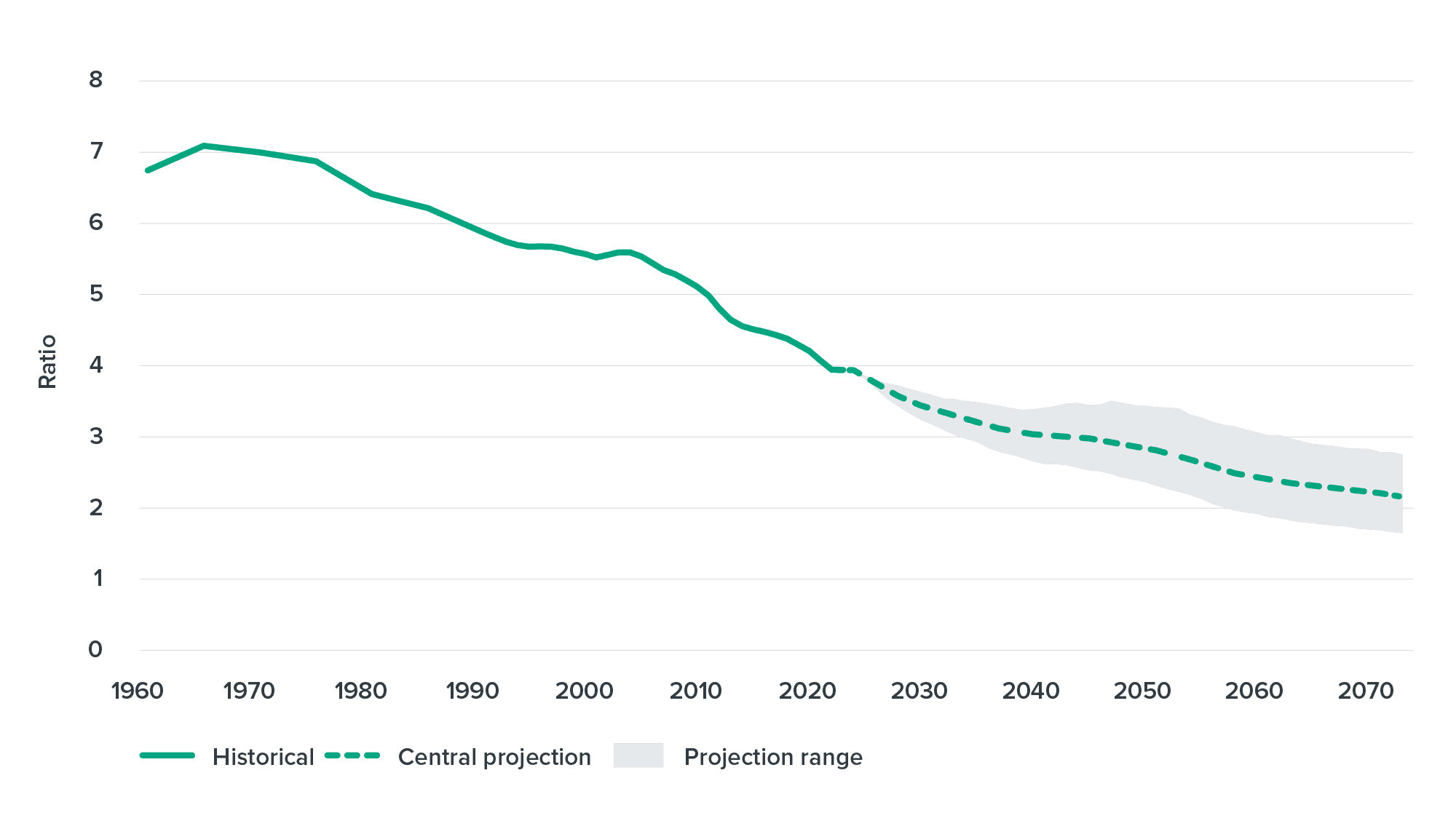
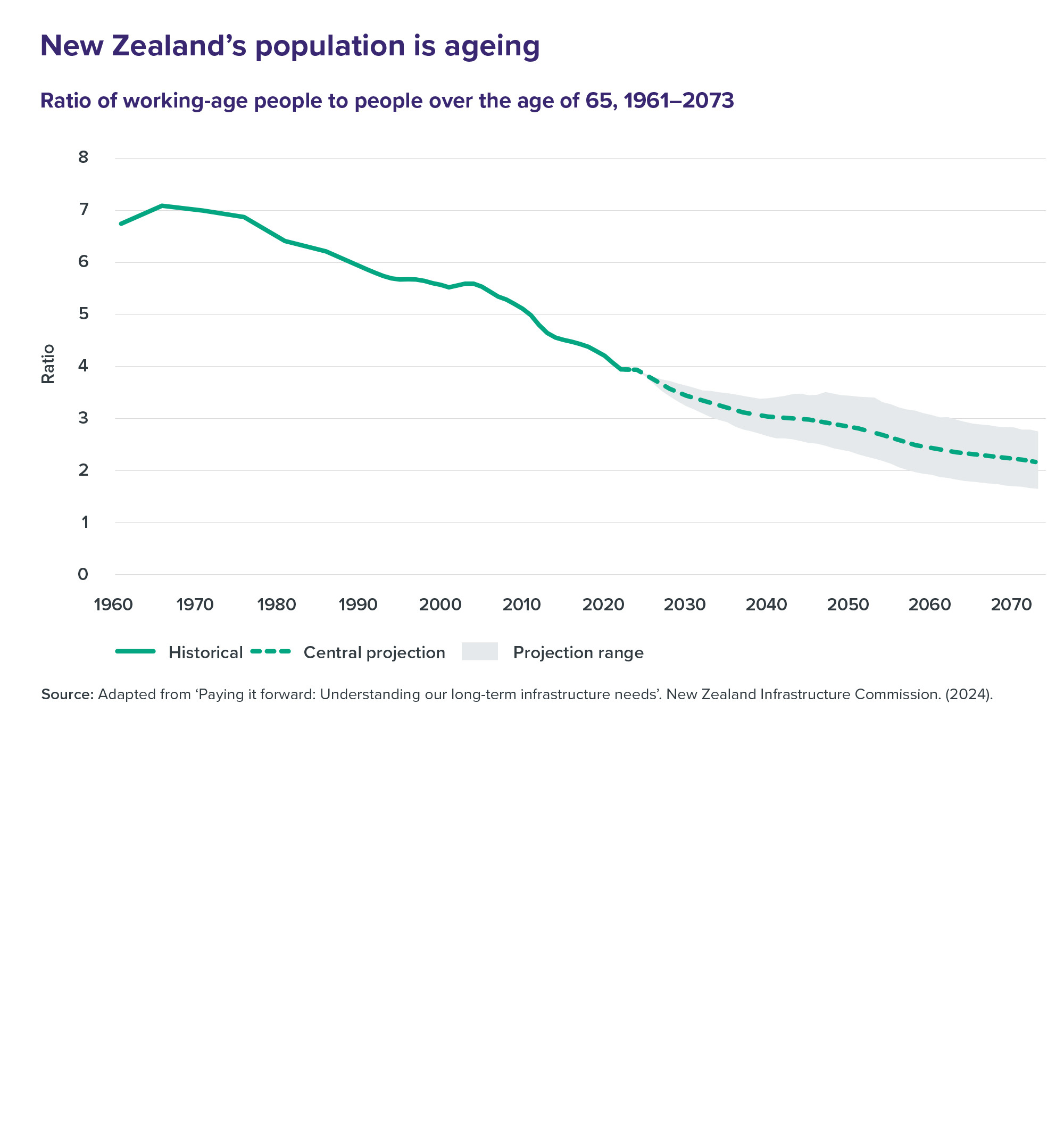
Economic and demographic changes will make it harder to pay for investment in the future. While costs are rising to build and maintain infrastructure, economic growth is forecast to slow and the population is ageing. In the early 1960s, New Zealand had seven working-age people for every one person over the age of 65. Today, this ratio is around four to one. By the 2070s the ratio will be as low as two to one, meaning significantly increased healthcare and other benefit costs and fewer workers to pay the taxes needed to fund it (Figure 5). This trend is more baked in and certain than other future projections, and not unique to New Zealand.
Productivity growth has been slow. Growth in the amount of goods and services produced per worker has slowed in recent decades.14 New technologies such as artificial intelligence may help to make firms and workers more productive, but if labour productivity growth remains weak in coming decades this will be mirrored by lower income growth. This will make it harder for households to afford to pay the taxes, rates and user charges needed to fund infrastructure investment.
New Zealand’s population is ageing
Figure 5: Ratio of working-age people to people over the age of 65, 1961–2073
Source: Adapted from ‘Paying it forward: Understanding our long-term infrastructure needs’. New Zealand Infrastructure Commission. (2024).
Central and local government are feeling the squeeze
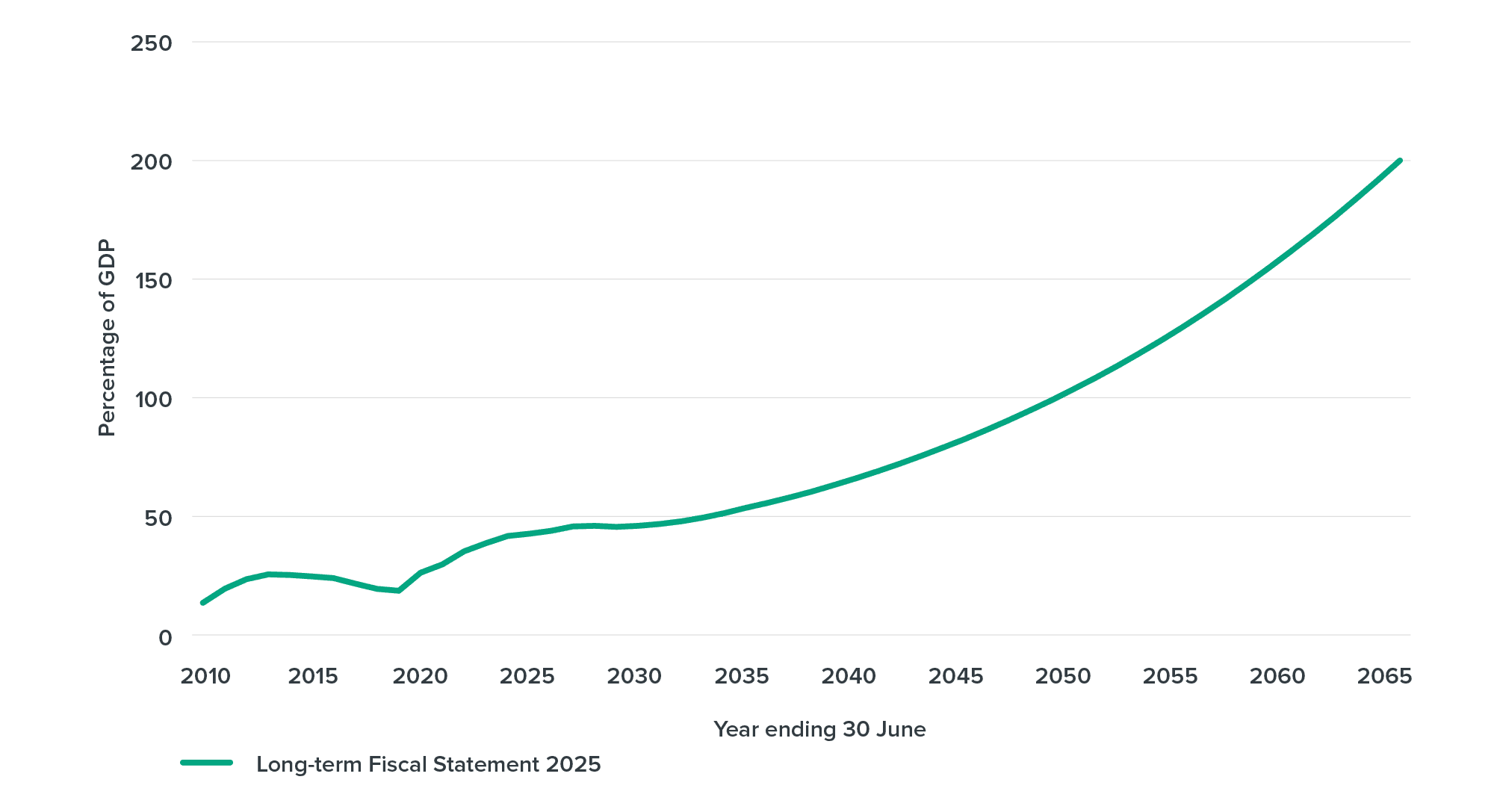
Central and local government face fiscal pressures. This will make it harder to sustain current per capita investment, let alone spend more. Central government has been running structural budget deficits.15 If policy settings don't change, the Treasury has warned that net Crown debt per New Zealander will increase sevenfold, from $34,600 today to $237,900 per person by 2065 (in 2025 NZD).16 Net debt as a share of GDP would go from 42.7% to 200% under this scenario, with interest repayment costs rising accordingly. (Figure 6)
In the short term this has been driven by several shocks. Government spending on these shocks, which include things like the Global Financial Crisis, the Canterbury earthquakes, and the COVID-19 pandemic, has averaged about 10% of GDP per decade.17 New Zealand’s Crown debt to GDP ratio is above the current Government’s fiscal sustainability targets, although it has generally remained lower than many other OECD countries with larger populations and less exposure to natural hazard events. In the long term, the fiscal trend is driven by hard-to-reverse changes like the ageing population and slowing productivity growth.
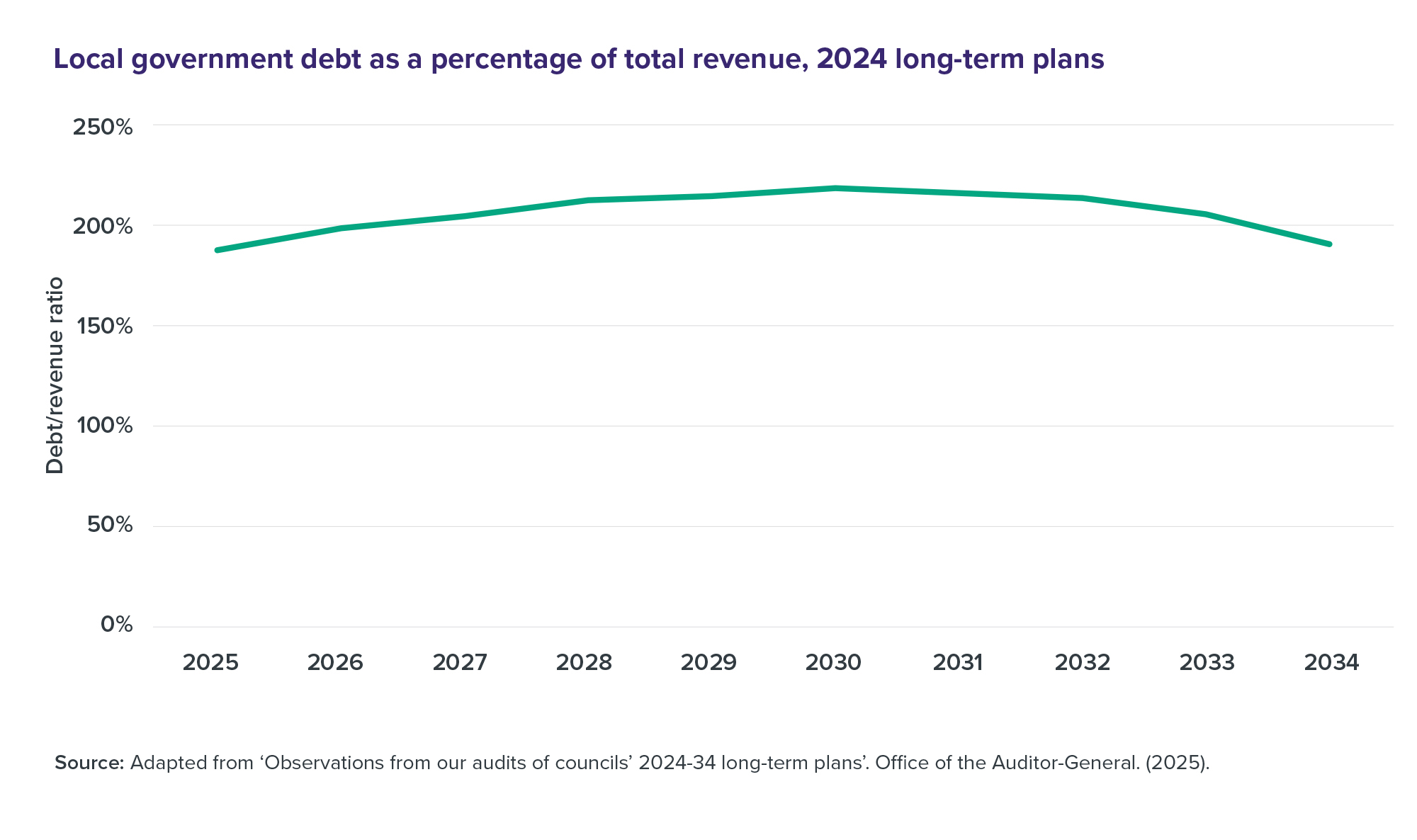
Local authorities also face fiscal constraints. This is due to the need to contain their own rising debt-to-revenue ratios (Figure 7). International credit rating agencies have downgraded bond ratings for many councils. Although the ratings are still high by global standards, this will manifest in increased borrowing costs and challenges financing further investment.18
Infrastructure funding will likely come under pressure. We cannot take it for granted that New Zealand will continue to have one of the highest government infrastructure investment rates among OECD countries. To sustain high-quality infrastructure services, we need to get smarter. That could be by reducing costs, easing the regulatory environment, or taking a more commercial approach to infrastructure development by vastly lifting the bar on project quality, and prioritising the projects that households and businesses will be willing to pay more for.
Both central and local government face fiscal constraints
Figure 6: New Zealand net core Crown debt projection assuming no change to fiscal policy
Source: From the Treasury’s September 2025 ‘He Tirohanga Mokopuna - Long-term Fiscal Statement’ report.
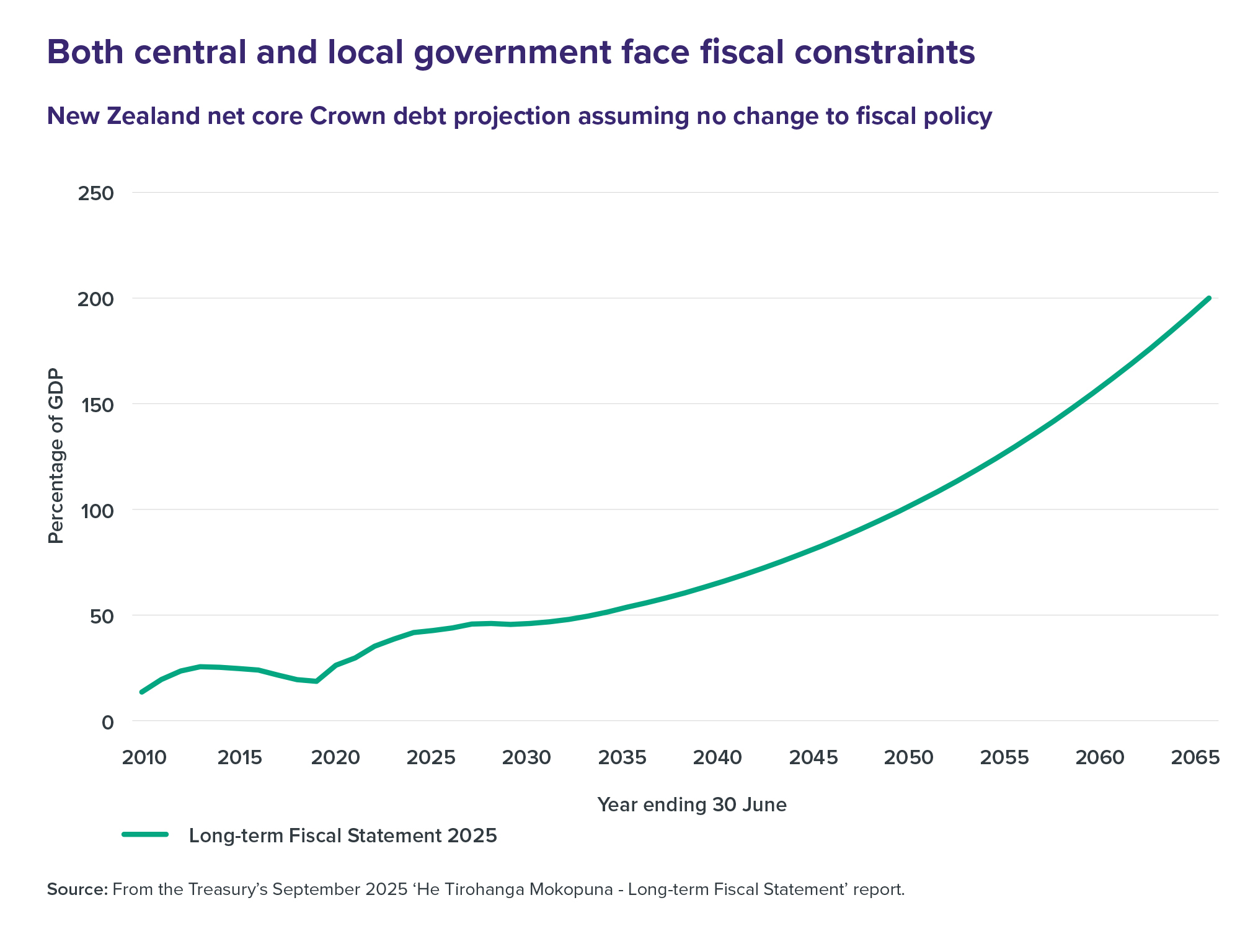
Figure 7: Local government debt as a percentage of total revenue, 2024 long-term plans
Source: Adapted from ‘Observations from our audits of councils’ 2024-34 long-term plans’. Office of the Auditor-General. (2025).
Households also face affordability constraints
Investment is ultimately constrained by what infrastructure users are willing and able to pay. Understanding community perspectives is essential to ensuring that the right infrastructure is delivered, in the right places, and at the right price. If communities do not value the services an investment would provide, they are unlikely to support the higher costs required to fund it.
Household affordability constraints will bite harder as our population ages. More people will be on fixed incomes, reducing their ability to absorb rising costs. More broadly, New Zealanders are concerned about the cost of living and inflation, which has been a priority issue in recent years. This makes building the social licence for increased charges needed to fund new investment more challenging. Increases in one area, like water or electricity, will make it harder for people to afford increases in other sectors.
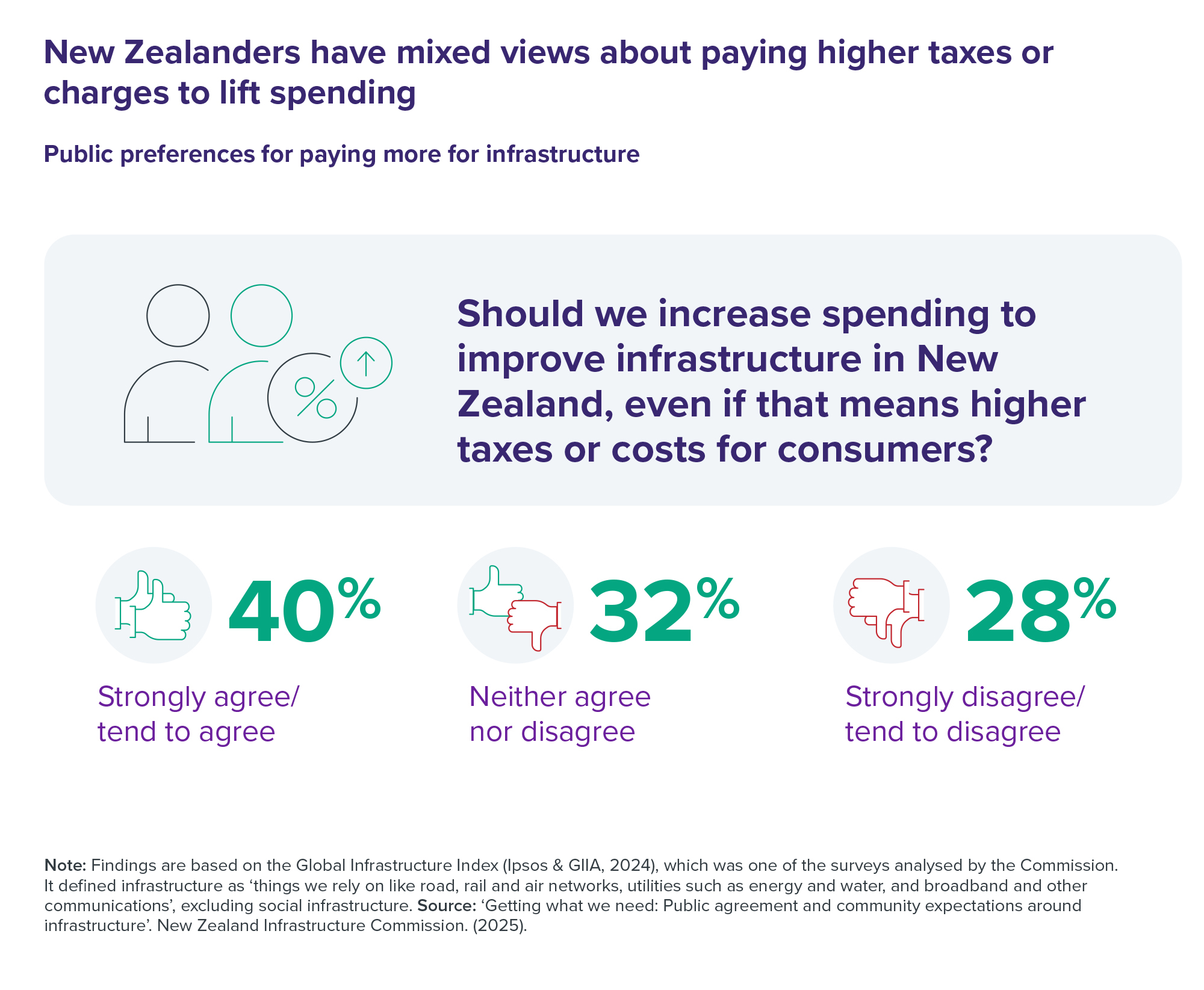
There are mixed views about paying more to increase infrastructure spending. While we are not always happy with the quality of our existing infrastructure, several representative surveys over the past decade found that most New Zealanders do not support increased spending on public infrastructure if it required them to pay higher taxes or charges to fund it (Figure 8).19
New Zealanders expect better infrastructure spending, not necessarily more. People are likely to be willing to pay a bit more for some things, such as healthcare or specific new projects that offer them large benefits, but across-the-board increases are more contested. New Zealanders appear to prioritise ensuring that the money already being spent on infrastructure is being spent well, and that the charges they pay are transparent and fair.
New Zealanders have mixed views about paying higher taxes or charges to lift spending
Figure 8: Public preferences for paying more for infrastructure
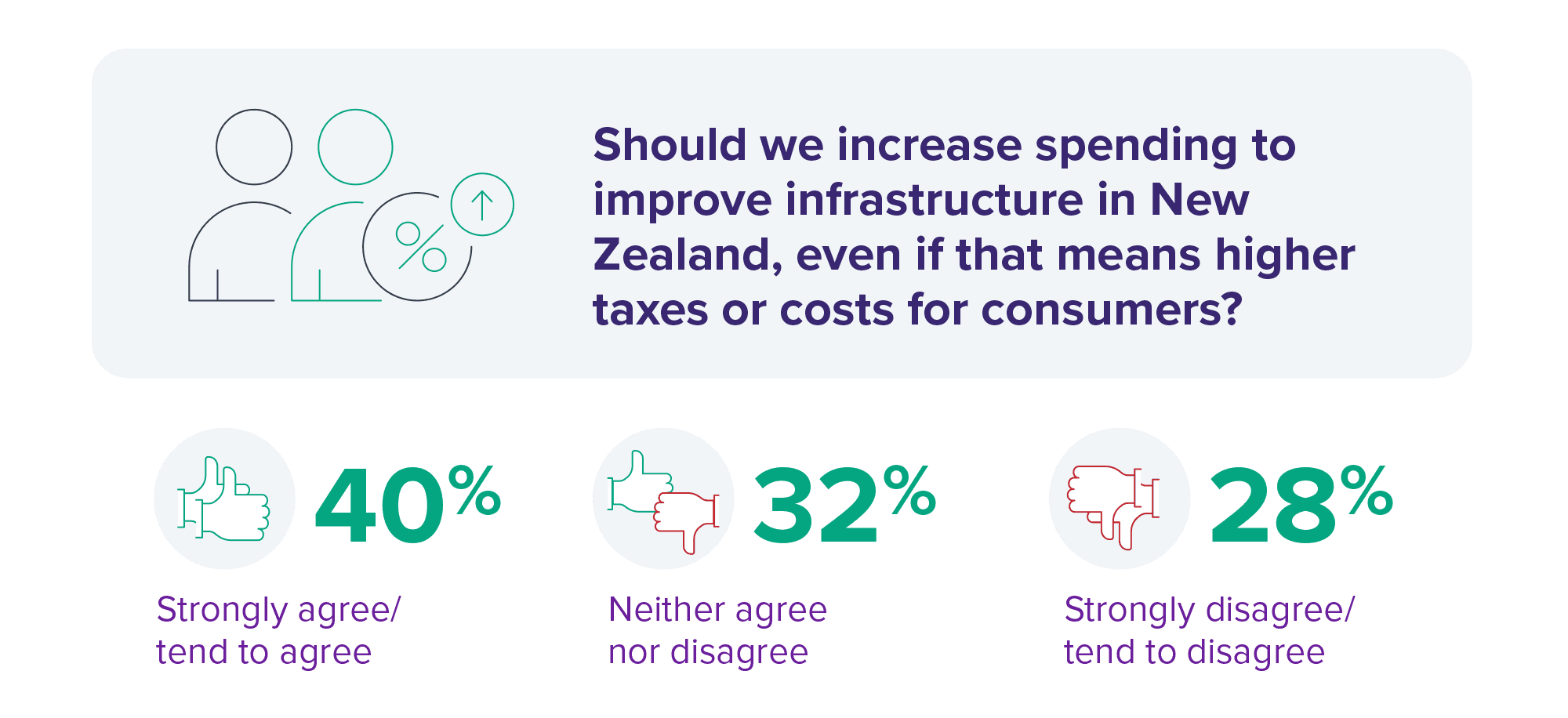
Note: Findings are based on the Global Infrastructure Index (Ipsos & GIIA, 2024), which was one of the surveys analysed by the Commission. It defined infrastructure as ‘things we rely on like road, rail and air networks, utilities such as energy and water, and broadband and other communications’, excluding social infrastructure. Source: ‘Getting what we need: Public agreement and community expectations around infrastructure’. New Zealand Infrastructure Commission. (2025).
There's broad public support for improvement
The Commission has a legislative mandate to build broad public support for the Plan and its approach, which aims to enhance the wellbeing of New Zealanders. To test this, we sought feedback on the themes and recommendations in the draft Plan. More than 2,700 responses were received from individuals and organisations, including a representative online survey of 1,001 New Zealanders, 1,557 general public responses to an online survey, and 122 written submissions.
There was broad support for the Plan’s direction. Respondents emphasised the need for long-term investment planning, better coordination between central and local government, improved accountability and transparency, stronger asset management, and a focus on affordability and efficiency. Many respondents highlighted the importance of climate resilience, equitable and sustainable funding, and prioritising both environmental and social outcomes alongside basic infrastructure.
Taking a long-term, needs-based approach was seen as critical, particularly to reduce investment instability and policy shifts. Some respondents linked workforce retention to the predictability of the infrastructure pipeline, arguing that project cancellations undermine confidence and drive talent offshore. Others called for cross-party consensus on evidence-based investment decisions and on nationally important projects.
There was a strong alignment with the recommendations in the draft Plan. Even on more debated issues – such as closing the transport funding gap and moving towards a user-pays approach to network infrastructure – most respondents were supportive. Many agreed that direct beneficiaries should contribute more but cautioned against funding mechanisms that were overly rigid or likely to hit lower-income households hardest. To guard against this, there was some support for pricing models that charge heavier users more and targeted protections for people less able to pay.
The Commission also engaged with some iwi and Māori organisations on the draft Plan and on its broader work programme. A key message was the importance of Te Tiriti o Waitangi and the need to embed Treaty settlement obligations and iwi perspectives into national policy and regulation relating to infrastructure. Iwi and Māori participants emphasised the need for genuine, ongoing partnership and expressed concern that engagement around infrastructure projects can be short term and transactional.
Iwi and Māori are increasingly taking on a strategic role in infrastructure investment and long-term whenua (land) development. Māori groups have sought to be involved in regional spatial planning in their rohe, or tribal lands, and for these processes to take an intergenerational approach. Protecting te taiao (the natural environment) and the need to better look after existing infrastructure were also strong themes in the feedback.
We need to lift our game to meet our needs
New Zealand needs an infrastructure investment approach that is affordable and that delivers the right services in the right places when they are needed. We need to fund projects with long-term value to users, including the maintenance and renewal of existing assets. Getting these things right means investment will contribute to maximising overall economic, social and environmental prosperity. However, there are significant challenges to achieving this that are unique to infrastructure.
Many things need to go right to ensure we get the best value from our spend. We need to understand the condition of the infrastructure we already have and what’s needed to keep it working. We need to plan, understand and account for the needs of current and future generations. We need project leaders who can successfully plan and design projects. We need to be able to protect land for future infrastructure projects through spatial planning and consent infrastructure projects efficiently. We need clients, construction firms and the wider workforce to work together to drive productivity. We need pricing that optimises how we build and use infrastructure.
A consistent investment approach is important, even if projects change over time. A ‘stop-start’ approach to infrastructure planning can undermine market confidence and add costs for ongoing investment programmes and large projects. We need to prevent policy churn and market volatility by making sure our investments are targeting the right problems with solutions that are affordable and deliverable. This means prioritising projects with the greatest benefits.
Infrastructure lasts for generations. Every new project represents an ongoing future commitment. Getting it right means leaving a positive legacy for future generations. Getting it wrong means leaving our children and grandchildren with assets that aren’t worth the debt repayments. If that happens, it will cut into their ability to fund their own priorities.
The Plan builds on a vision
The Commission delivered the New Zealand Infrastructure Strategy (Rautaki Hanganga o Aotearoa) in 2022. The Strategy outlines a vision for New Zealand where infrastructure lays a foundation for people, places and businesses to thrive for generations. Progress has already been made against some of the 68 recommendations in the Strategy (see Appendix Two), including in the areas of critical infrastructure resilience and demand management.20
The National Infrastructure Plan builds upon the Commission’s ongoing work. Since delivering the Strategy, the Commission has continued to refine the National Infrastructure Pipeline, which now captures data on nearly 12,000 initiatives – a greater share of national activity than many comparable overseas tools. We developed the Infrastructure Priorities Programme to provide a standardised, independent tool for assessing project readiness. And we continued to develop our evidence base, publishing papers on a range of topics from pricing and asset management to a deep dive looking at 150 years of infrastructure investment in New Zealand.
In 2024, the Minister for Infrastructure asked the Commission to develop this Plan. We were asked three questions: What infrastructure will New Zealand need, and what should we spend over the next 30 years? What investment is planned over the next 10 years? And where are the gaps between what we need and what is currently planned – and how can they be closed?
The Plan lays out an approach for investment that can meet New Zealand’s long-term needs. In it, we outline what a sustainable level and mix of infrastructure investment would look like over the next 30 years based on known demand drivers and grounded by what New Zealand has historically been willing to invest. We have worked with infrastructure providers to refine the Pipeline, allowing us to contrast our Forward Guidance with what’s being planned in the next decade to get a sense of any ‘gaps’.
Infrastructure must serve different needs in different places, and trade-offs are unavoidable. Spending heavily in one area limits what can be invested elsewhere. Even so, there is broad agreement on core priorities such as maintaining and renewing what we already have, strengthening resilience to natural hazards, and investing in our hospital system.
Not every major project will attract consensus, but that need not prevent progress. Political contestability is normal, and priorities will shift over time. What matters is staying focused on the fundamentals – looking after existing assets, delivering projects well, planning efficiently, and being transparent about costs and outcomes.
The Strategy established the vision for where we need to go. With its 16 clear system-level recommendations and ‘key actions’ to address 10 specific priority areas, the Plan provides the pathway to get there.