People build projects. If we want better projects, we must invest in the people who lead them.Public sector infrastructure leader
Content
Content

6.3. Growing a skilled infrastructure workforce
Te whakatipu i te rāngaimahi tūāhanga whai pūkenga
Context
New Zealand struggles with fluctuations in workforce demand. Our position as a small, isolated island nation with a relatively concentrated construction market, periodic boom-and-bust investment cycles, and ambitions to build significant projects relative to the size of the market makes it challenging to maintain the workforce skills and capability our country needs.
Our workers are mobile domestically and internationally. It is hard to recruit, develop, and retain skilled people when there is significant uncertainty about the volume and smoothness of the forward work programme of civil, commercial, and residential construction work. Sharing a common labour market with Australia, a larger and wealthier country, exacerbates the risk of losing talent. Workforce constraints can limit the ability to deliver what New Zealand needs and drive project cost inflation and risk.
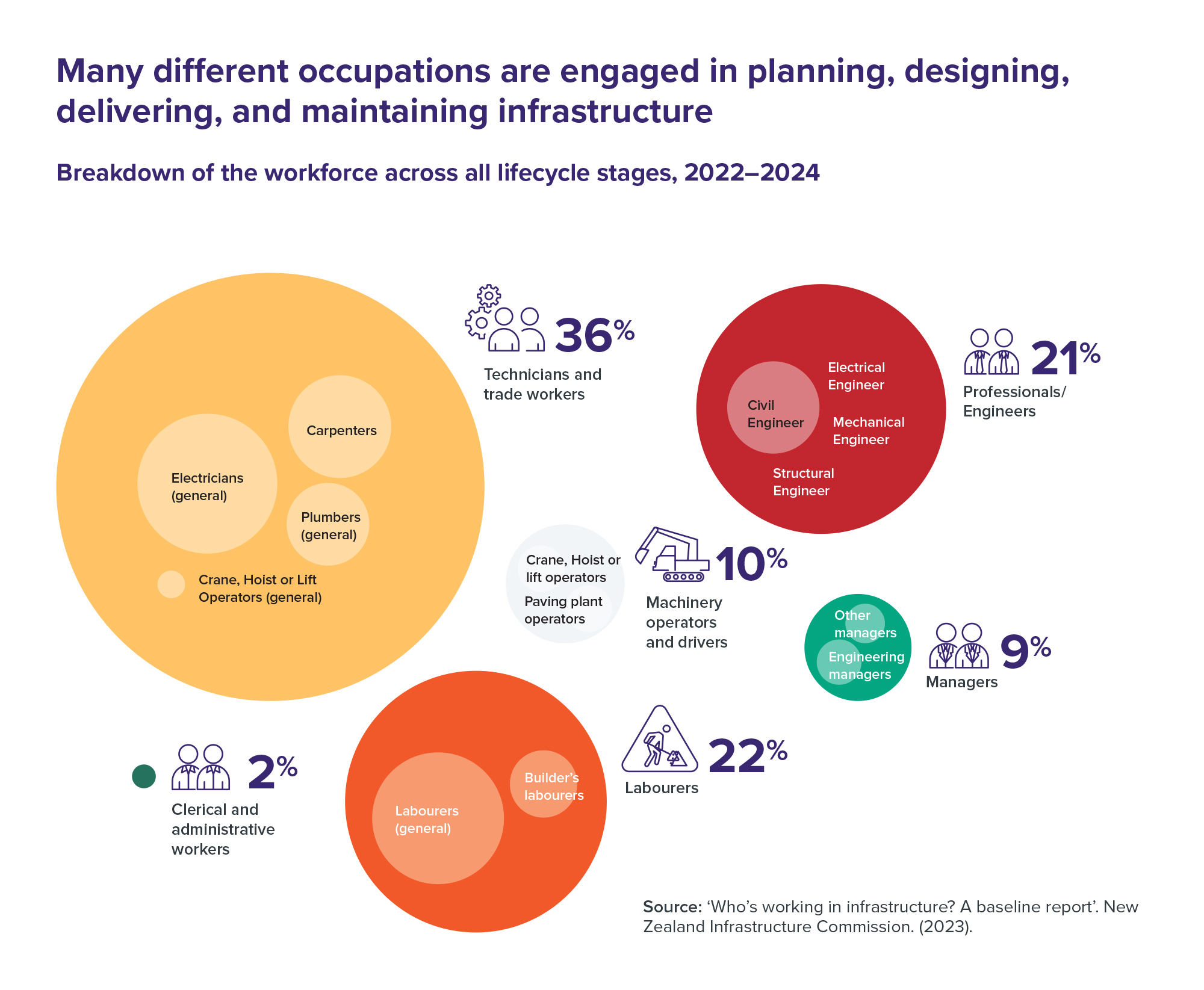
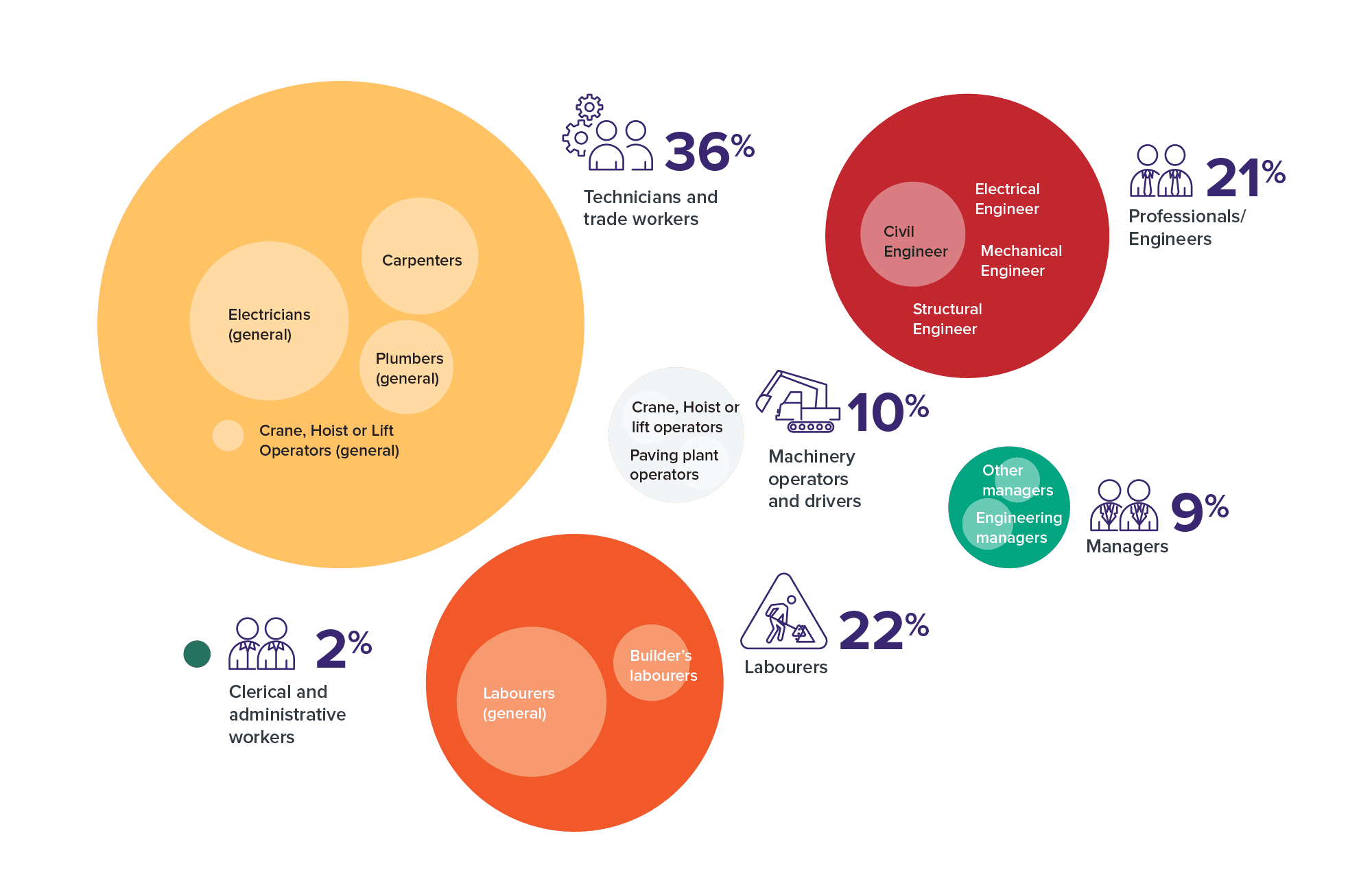
New Zealand needs a workforce that is productive, efficient, and the right size for the job. The existing infrastructure workforce comprises more than 100,000 full-time equivalent workers spread across more than 100 distinct occupations.136 Different skills are needed in planning, design, construction and maintenance of infrastructure (Figure 41). Across all occupations, around 14% of infrastructure workers are engaged in planning and design, 46% are constructing new assets, and a further 40% of infrastructure workers are engaged in asset management and maintenance.
Without the right workforce we won’t achieve our infrastructure ambitions. The National Infrastructure Pipeline captures data on $275 billion of planned infrastructure projects. Without the skilled workers and productive construction firms to deliver them, these projects will remain exactly that, plans.
Many different occupations are engaged in planning, designing, delivering, and maintaining infrastructure
Figure 41: Breakdown of the workforce across all lifecycle stages, 2022–2024
Source: ‘Who’s working in infrastructure? A baseline report’. New Zealand Infrastructure Commission. (2023).
Strategic direction
Workforce planning looks ahead to future demand for skilled workers
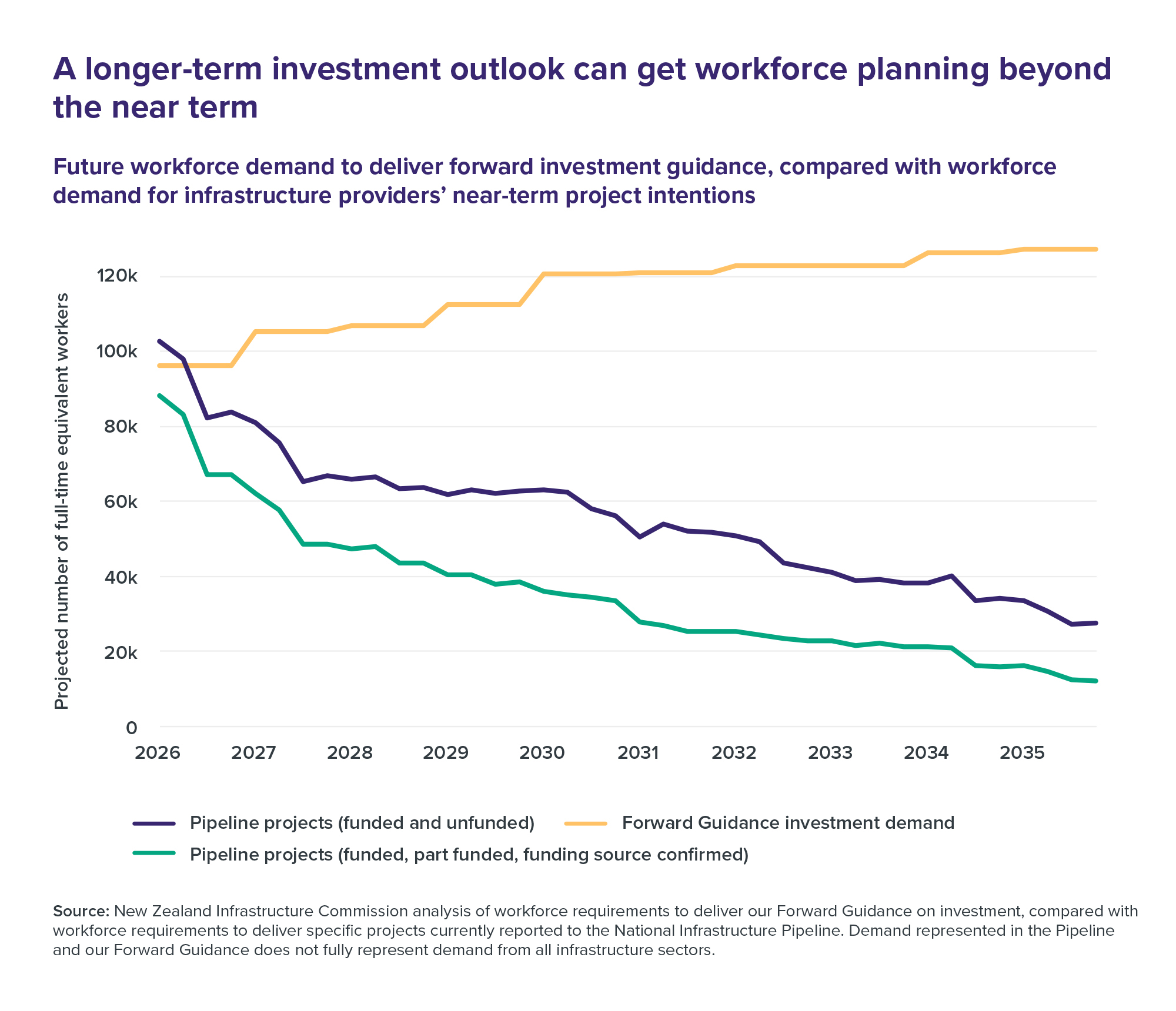
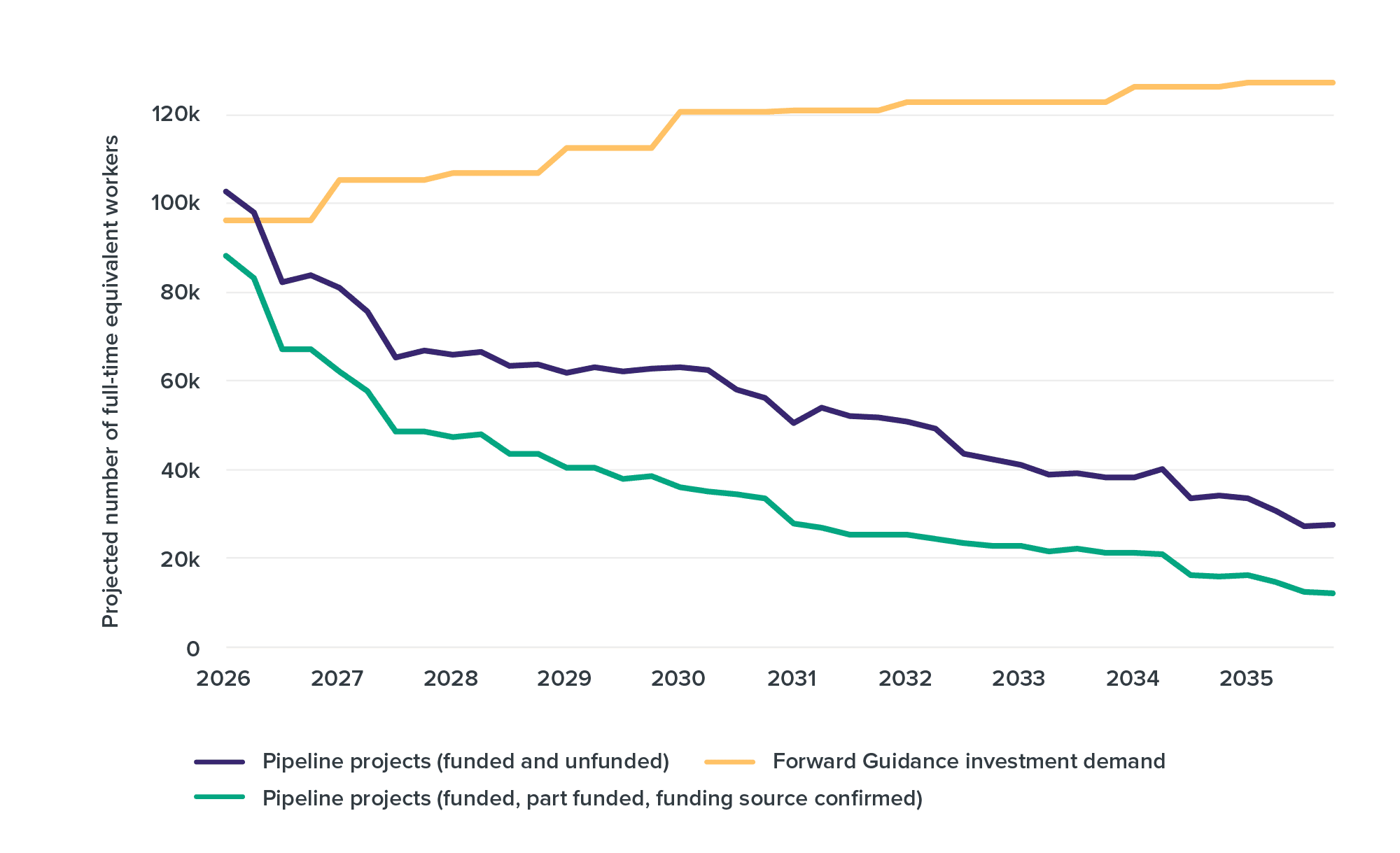
More infrastructure investment will require more workers. The Commission’s Forward Guidance can help model the size of the future workforce required to renew and replace our existing infrastructure and build the new assets necessary to meet demand over the next 30 years (Figure 42). Because New Zealand’s population will grow older, a larger share of the working-age population will be engaged in the infrastructure workforce. Productivity changes will also have an impact, although this is harder to forecast.
Our Forward Guidance provides a longer-term view that can be useful for workforce policy. Taking a long-term view allows us to match forecast demand for infrastructure with the workforce that would be required to deliver it. This could inform workforce development requirements and activities, such as vocational training and immigration policy settings. In the near term, the National Infrastructure Pipeline coordinates information on specific projects that are in planning, procurement, or delivery, including when these projects are intended to start.
Building capability requires consistent investment decisions. As the single biggest infrastructure investor, central government needs to strive for consistent and well-coordinated investment and to work with the sector to develop the workforce required to deliver on our aspirations. While design and engineering skills can be contracted out, it’s important that the public sector becomes a more sophisticated client to support investment in the longer-term capability our country needs.
A longer-term investment outlook can get workforce planning beyond the near term
Figure 42: Future workforce demand to deliver forward investment guidance, compared with workforce demand for infrastructure providers’ near-term project intentions
Source: New Zealand Infrastructure Commission analysis of workforce requirements to deliver our Forward Guidance on investment, compared with workforce requirements to deliver specific projects currently reported to the National Infrastructure Pipeline. Demand represented in the Pipeline and our Forward Guidance does not fully represent demand from all infrastructure sectors.
The sector establishes broader pathways into the workforce
To meet long-term infrastructure needs, New Zealand must sustain the pipeline of people entering infrastructure careers. In the near term, our capacity to plan, design, deliver and maintain assets is limited by the size, composition and regional distribution of the workforce. Longer term, population ageing means we will need to recruit, retain and develop more workers to keep pace with investment needs. Some technical roles already face pressure: around 30% of electrical engineering and telecommunications technicians are aged 55 or over.137 Making training and recruitment pathways more accessible and attractive to younger workers will be essential.
Broadening Māori participation across the infrastructure lifecycle is a key opportunity. At present, Māori make up 18% of the overall infrastructure workforce, with higher representation in labouring and machinery operating and driving occupations and lower representation in professional and managerial occupations.138 Participation is rising across many occupations, and the number of Māori-owned construction businesses increased by over 35% from 2013 to 2023.139 These firms provide important pathways into training and employment but can face barriers to participating in procurement processes, especially for large contracts.
Lifting women's engagement with infrastructure can also help to grow the workforce. Women account for just 11% of the infrastructure workforce, compared with 47% across the whole economy. Participation is low across most infrastructure occupations – for instance, women account for about one-fifth of professionals, such as engineers, and 15% of labourers.140 Younger cohorts show similar patterns, indicating that sustained efforts to improve recruitment, retention and progression would be needed to shift participation over time.
Public infrastructure providers build and maintain capability to deliver
Government needs to act as a sophisticated client of infrastructure. A capable workforce is not limited to engineers and trades. Effective delivery also depends on the commercial, governance, and project leadership skills inside public infrastructure agencies. While design and construction work is procured from the market, public infrastructure providers must retain enough in-house expertise to shape scope, oversee delivery, manage performance, and remain accountable for outcomes. These strategic functions cannot be outsourced.
Strong leadership capability is central to project delivery. Large, complex projects depend on skilled project directors and senior responsible owners (typically called ‘project sponsors’ in the commercial sector) with the judgement to manage risk, align stakeholders, and maintain delivery discipline. Public sector capability gaps in these roles contribute to delays, cost overruns, and repeated project rescoping.141 We need a sector-wide approach to developing capability through formal training pathways, secondments, and opportunities to progress between projects.
Without clear governance, even strong project teams struggle. Public infrastructure project leaders often operate within fragmented or overlapping governance arrangements that slow decision-making and blur accountability.142 System reviews consistently identify governance confusion as a driver of delay.143 Strengthening governance structures for infrastructure projects is therefore as important as improving individual capability.
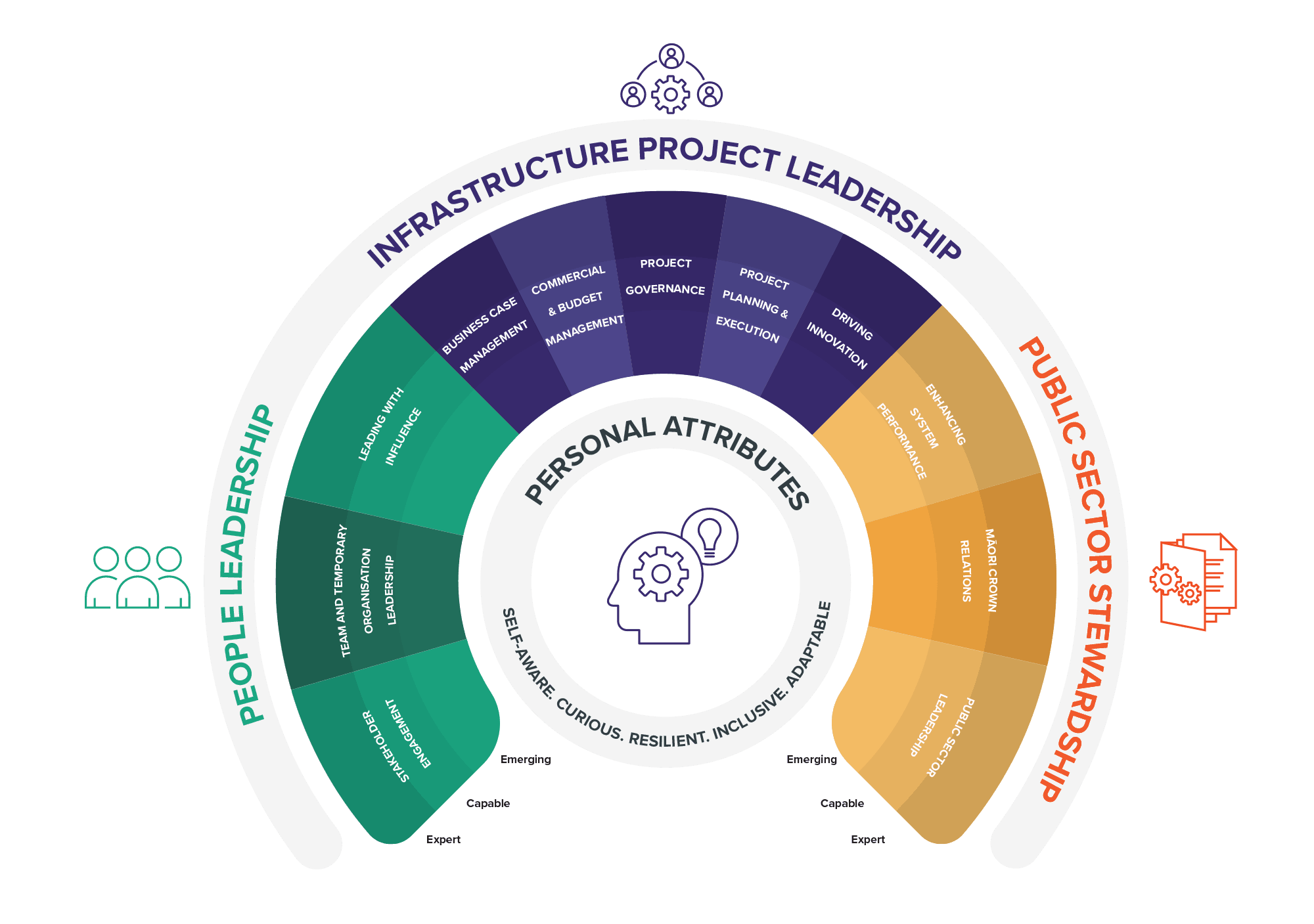
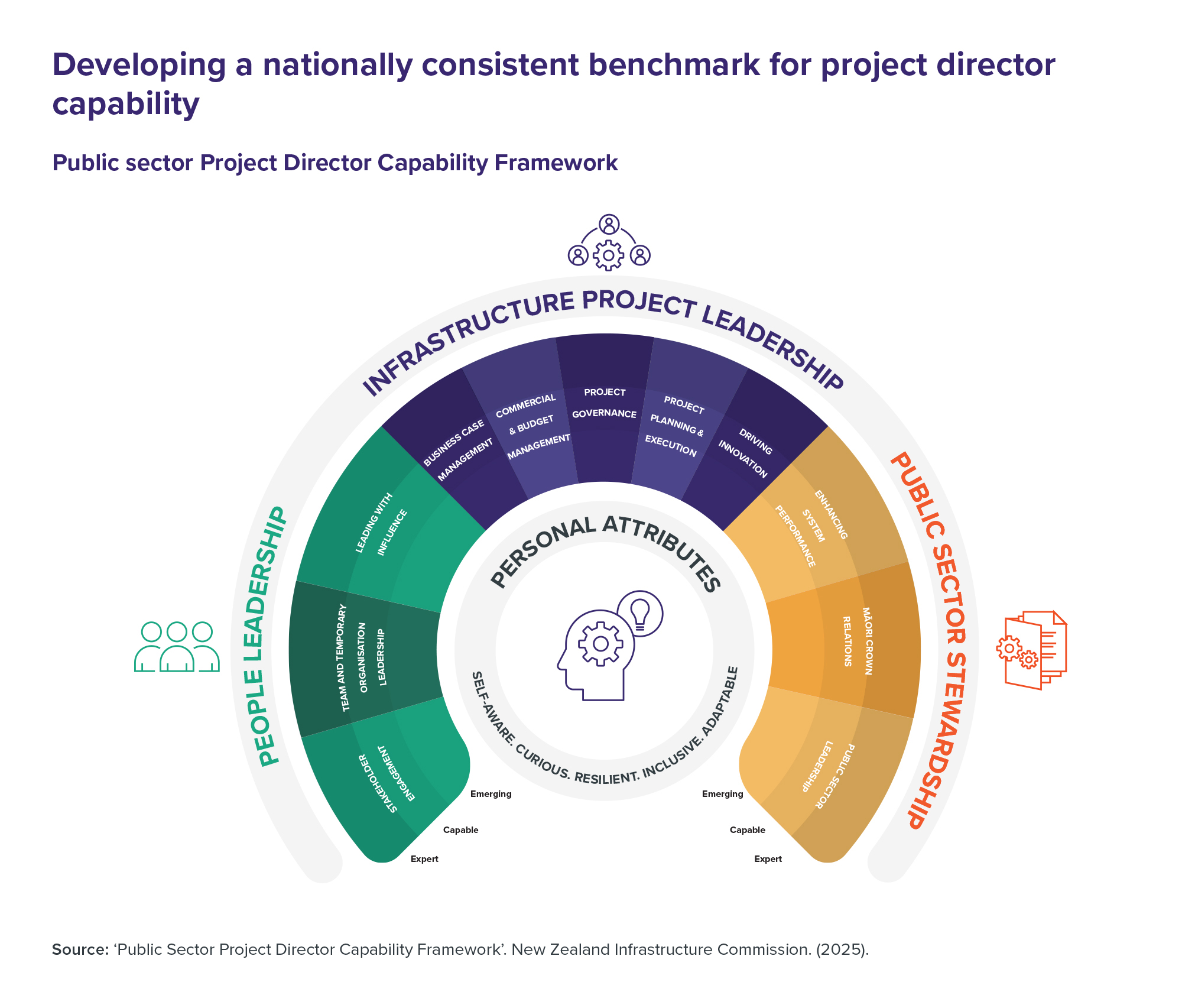
Agencies should apply consistent capability standards to lift project leadership. The Commission’s Project Director Capability Framework provides a consistent national benchmark for the skills required to lead complex projects, supporting recruitment, professional development, and self-assessment across agencies (Figure 43).144 Complementary guidance supports better appointment of senior responsible owners and helps agencies match project leadership roles to the skills required. Applying these tools helps promote clearer accountability, better role definition, and more consistent project leadership across the system.
Developing a nationally consistent benchmark for project director capability
Figure 43: Public sector Project Director Capability Framework
Source: ‘Public Sector Project Director Capability Framework’. New Zealand Infrastructure Commission. (2025).
Public infrastructure providers engage the market through consistent, high-quality procurement
Procurement practices need to be strengthened. New Zealand has sound procurement rules and standard form contracts such as NZS 3910 Conditions of Contract for Building and Civil Engineering Construction.145 However, uneven implementation weakens outcomes from procurement.146 As a result we rank last in the OECD on a measure of infrastructure procurement governance.147 Poor scoping, weak commercial judgement, or overly complex tendering all raise cost and delivery risks. Agencies need to run disciplined procurement processes that match approach to project scale and risk and maintain accountability for delivery.
Lifting commercial capability inside agencies, not just relying on external support, is important. Procurement performance varies because agency capability varies. Tender documents are often inconsistent or overly complex, supplier feedback remains patchy, and agencies tend to introduce bespoke contract conditions to the standard-form contract.148 This creates barriers to wider participation in infrastructure procurement. Meanwhile, collaborative contracting models, like early contractor involvement, can lead to improved contract performance and better project outcomes, but uptake is low and realising the benefits relies upon clear scoping and allocation of responsibilities.149
Better procurement depends on clear and consistent expectations. By investing in leadership and procurement capability and applying procurement rules with discipline, infrastructure providers can strengthen supplier relationships, develop capability in the market, and create the conditions for successful delivery.

Recommendation 15
Coordinated workforce development
Align workforce development planning and policy with infrastructure investment and asset management plans and the Commission’s independent view of long-term needs.
Implementation Pathway
This could be implemented by:
- Informing workforce development activities with enhanced modelling of labour capacity and workforce demand required to deliver investment intentions in the National Infrastructure Pipeline.
- Using the Commission’s independent assessment of long-term infrastructure needs to identify long-term workforce demands.
- Coordinating education, training, and immigration policy settings to address skill gaps.
Responsible agencies
New Zealand Infrastructure Commission; Ministry of Business, Innovation and Employment; Tertiary Education Commission; and others
Timeframe
2026 onwards.
Recommendation 16
Public sector project leadership
Strengthen public-sector project leadership through a consistent, system-wide approach to appointing, developing, and supporting infrastructure leaders.
Implementation pathway
This could be implemented by:
- Creating a professional standard for public sector infrastructure leadership.
- Designing a cross-agency talent management framework for recruitment, development, and mobility.
- Specifying, and funding, leadership development as a core input to project delivery so capability building is systematic, not optional.
Responsible agencies
New Zealand Infrastructure Commission and Public Service Commission
Timeframe
2026–2029.