Content
Content

6.4. Improving oversight of infrastructure providers
Te whakapai ake i te whakatātare i ngā kaiwhakarato tūāhanga
Context
Infrastructure exists to serve people. Providing an enabling environment, electrifying the economy and resourcing the infrastructure workforce only matter if the projects being delivered are valued by the people who use and pay for them. If we get it right, infrastructure can set the scene for people to survive and thrive, now and into the future.
People tell us what they value by what they’re prepared to pay. Ultimately, all infrastructure is funded directly by users or by society as a collective through taxes and rates. If direct beneficiaries aren’t prepared to pay more for service improvements such as a slightly shorter commute or faster internet, infrastructure providers can use that feedback to determine whether a project makes sense.
Central government is the single biggest infrastructure investor in New Zealand, and the ‘referee’ for other providers. It has several levers to make sure that infrastructure investment decisions reflect the long-term needs and aspirations of people who use and pay for infrastructure, including oversight mechanisms and economic regulation.
But these levers are only effective if they are informed by a deep understanding of what infrastructure users want and value. Decision-makers need to understand and navigate different views about what’s fair to meet the infrastructure challenges ahead. Regularly undertaking representative surveys of New Zealanders is one way of ensuring that community preferences are being met.
Strategic direction
All infrastructure sectors have effective governance and oversight
Effective governance and oversight ensure that infrastructure providers act in the long-term interests of those who use and pay for their services. Because many infrastructure sectors are monopolistic or have limited competition, incentives to invest efficiently or maintain quality can be weak. Providers may build too much, maintain too little, or invest in the wrong things – choices that do not reflect what users value. Clear governance, strong oversight, transparent information, meaningful accountability, and appropriate autonomy are therefore essential in every sector (Figure 44).
Governance should align with the long-term interests of infrastructure users. Funding and pricing models can help ensure that decision-makers are incentivised to deliver services that users value. Good governance also requires processes that help providers understand user preferences, service priorities, and willingness to pay for different service levels. Local government and sector regulators such as the Electricity Authority are legally required to consult before making decisions, but consultation or participatory processes can be valuable even without a legal requirement.
External oversight protects user interests. Oversight builds public trust by setting clear expectations for performance, investment, and service delivery, and by monitoring whether providers are meeting these expectations. It provides assurance that services are delivered efficiently and sustainably. Because ownership models differ across central government, local government, and commercial providers, oversight mechanisms must be tailored to each context.
Transparency enables accountability for performance. Performance information should be accessible and understandable to the people who use and pay for infrastructure. This allows decision-makers and the public to assess performance. Examples include the Commerce Commission’s information disclosure regime for regulated sectors, the Electricity Authority’s market performance reporting, and financial disclosures required by the Local Government Act 2002. For central government infrastructure, the Public Finance Act 1989 provides the core framework for performance and financial reporting.
Accountability ensures that performance expectations are met. Information disclosure helps highlight performance issues, but it is not always enough to drive improvement. Providers should be subject to monitoring, evaluation, and meaningful consequences for underperformance. Strong accountability mechanisms promote continuous improvement and maintain public confidence in infrastructure services.
Autonomy supports better decisions and better outcomes. Infrastructure providers need the flexibility to deliver against well-defined expectations and respond to changing service needs. Autonomy enhances accountability by making providers visibly responsible for their decisions. It allows them to tailor investment and operations to the needs of specific places or user groups. Governance and oversight mechanisms that overly constrain decision-making are unlikely to deliver good outcomes for users.
How we govern infrastructure affects how well our needs are met
Figure 44: Best practice principles for aligning infrastructure providers with consumer interests

1. Governance
Decision-making should align with the long-term interests of infrastructure users, including through use of pricing and funding models that incentivise performance and value. Providers should use good processes to ensure they understand users’ preferences, service priorities, and willingness to pay and make trade-offs.

2. Oversight
Oversight arrangements should set clear expectations for performance, investment, and service delivery. They should monitor whether providers act in the long-term interests of users and provide assurance that infrastructure is operated efficiently and sustainably.

3. Transparency
Transparent performance and financial information should enhance accountability by allowing decisionmakers and users to assess whether providers are meeting expectations. The focus should be on genuinely useful information which is accessible and understandable by the public. This information should align with existing reporting, stay proportionate to scale, and be standardised to allow for comparison and benchmarking, where possible.

4. Accountability
Providers’ performance should be subject to monitoring and evaluation by an independent party with the power to enforce meaningful consequences for underperformance. Accountability mechanisms should promote continuous improvement and maintain public confidence in infrastructure services.

5. Autonomy
Infrastructure providers should have the autonomy to deliver against well-defined expectations. Autonomy enhances accountability and gives infrastructure providers the authority and freedom to adapt to changing circumstances.

Source: New Zealand Infrastructure Commission. (2025).
Governance and oversight are appropriate to context
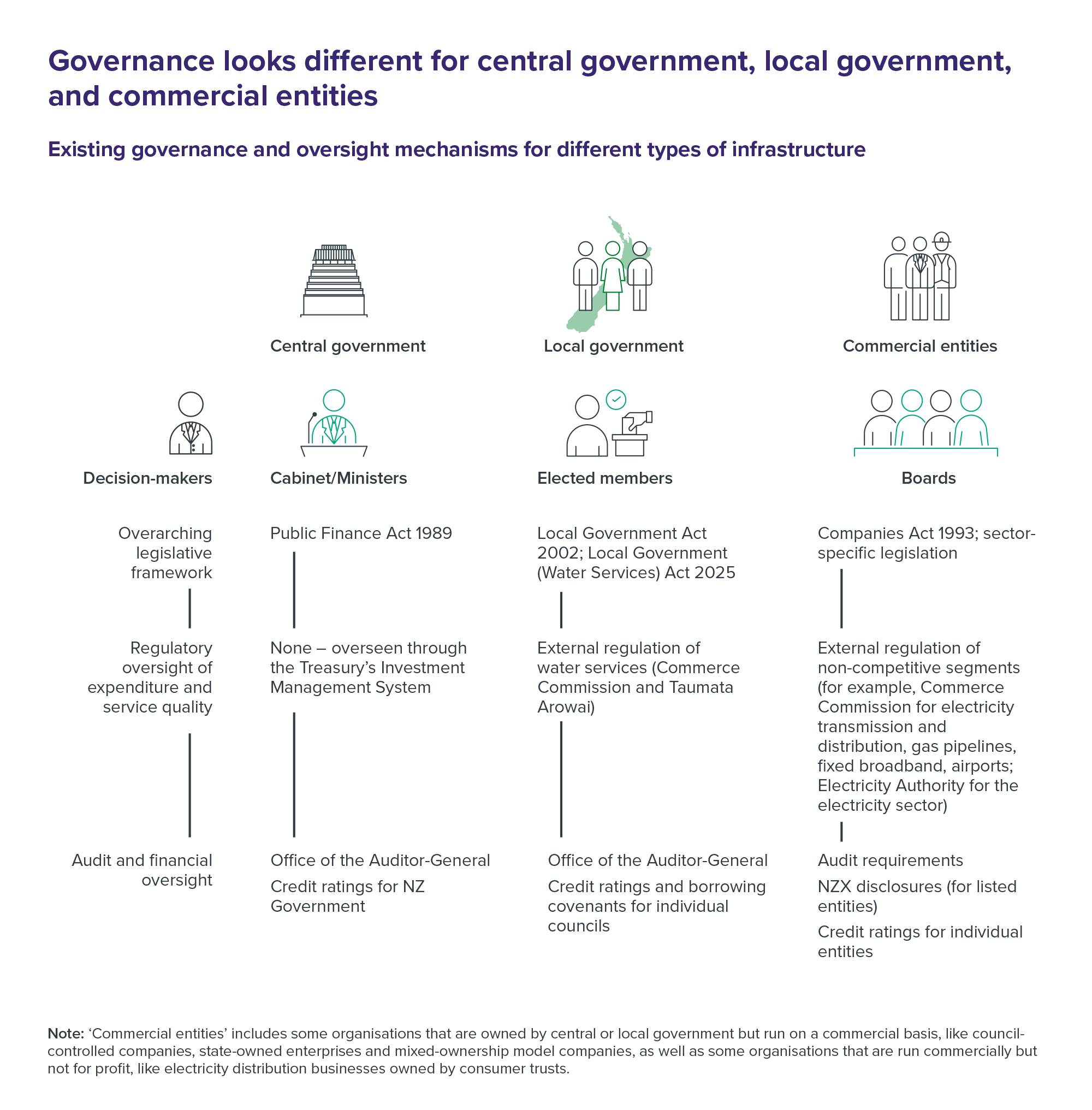
Different governance and oversight arrangements apply across infrastructure sectors because providers face different incentives and responsibilities. Central and local government providers are governed by elected representatives accountable to voters. Their oversight arrangements are tailored to this context (Figure 45). By contrast, commercial entities are governed by boards accountable to shareholders, and many are subject to additional regulatory oversight of their expenditure and service quality.
Economic regulation is an important oversight tool for monopoly infrastructure. The Commerce Commission uses regulation to replicate the effects of competition by ensuring prices are fair, consumers are protected, and providers remain customer-responsive and innovative. Forms of economic regulation include information disclosure, which promotes transparency, and price-quality regulation, which sets limits on revenue, minimum service quality standards, and penalties for non-compliance.
Economic regulation is most effective where providers fund investment from their own revenues and have autonomy over investment decisions. Commercial and local government providers meet these conditions, meaning the Commerce Commission’s decisions and penalties can drive better performance and investment behaviour.
Local government settings and accountabilities are coherent
Local government reforms and shifting policy settings need to ensure the sector is empowered to plan and deliver infrastructure. Local government accounts for around a quarter of all infrastructure investment, so it’s imperative that councils have clarity on their roles and functions, and certainty about their ability to raise funds to invest in essential infrastructure. Councils have navigated a series of reforms in recent years, including changes in the important areas of water, resource management and building control. This has contributed to policy uncertainty and increased costs.150 The sector, which is facing fiscal constraints, has also voiced concerns about additional responsibilities not being matched with new funding. Future changes have been announced, including a policy to constrain rates increases.
Oversight mechanisms should ensure that councils are acting as responsible stewards of community infrastructure. Councils are accountable to voters through triennial elections, and transparency is supported by audit provisions under the Local Government Act 2002. Several new oversight mechanisms are now being introduced: the Commerce Commission will apply economic regulation to water and wastewater services, complementing the role played by the Water Services Authority – Taumata Arowai in setting water quality standards; and the Department of Internal Affairs has developed performance benchmarking, allowing ratepayers to assess how their council compares across metrics like capital spending, rates increases and debt levels.151 New oversight mechanisms for local government should consider the benefits of additional transparency against the cost of compliance.
These changes need to be implemented in a coherent way. Ongoing reforms and policy changes affecting local government should be considered in the round, with an eye to ensuring that councils can continue to maintain and invest in infrastructure. Changes should seek to strengthen regional planning processes to better align land use and infrastructure and acknowledge the benefits of national standards and consistency, including tools like standardised planning zones. At the same time, local government needs to have the incentives, autonomy, levers, and access to funding tools to make place-based decisions, maintain their assets, and represent and serve their communities.
Governance looks different for central government, local government, and commercial entities
Figure 45: Existing governance and oversight mechanisms for different types of infrastructure
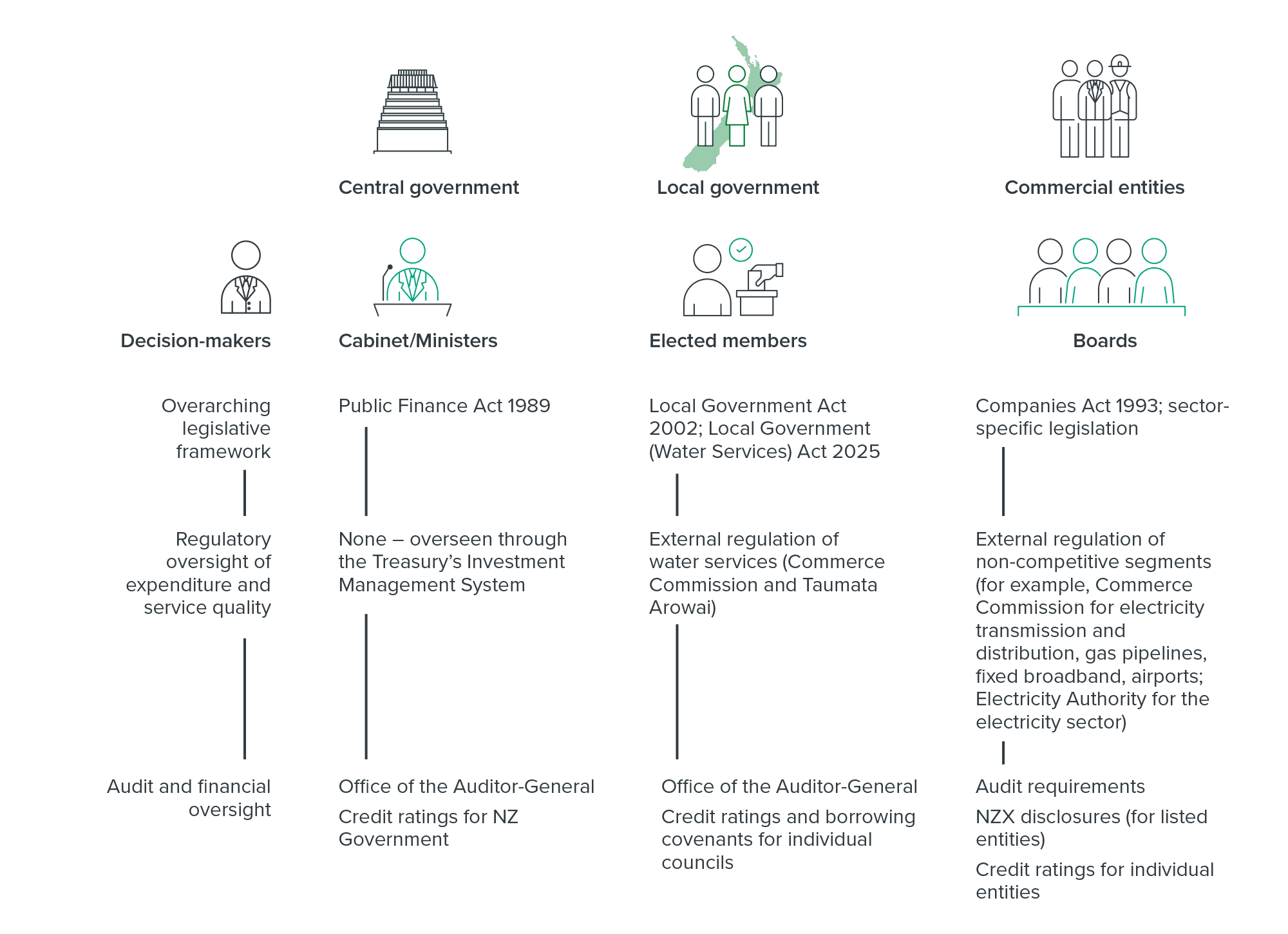
Note: ‘Commercial entities’ includes some organisations that are owned by central or local government but run on a commercial basis, like council-controlled companies, state-owned enterprises and mixed-ownership model companies, as well as some organisations that are run commercially but not for profit, like electricity distribution businesses owned by consumer trusts.