Content
Content

3.2 Using the right tools to pay for infrastructure
Whakamahia ngā utauta tika ki te utu i ngā tūāhanga
Context
New Zealand currently invests just over $20 billion a year on infrastructure. This covers capital investment in new and existing assets, not the ongoing costs of maintenance or debt repayments. While finance can help spread the cost of projects over time, New Zealanders still ultimately pay for the hospitals, schools, water systems, telecommunications, and transport networks that support our way of life. User charges, taxes and rates are the three main ways we do this.
Pricing and funding settings determine what resources are available to build, maintain, and operate assets. When working well, these settings should enable infrastructure providers to invest sufficiently to meet long-term user demands, while discouraging unaffordable spending and excess capacity.
These settings also help to maximise the benefits we achieve from infrastructure networks. For example, time-of-use charging for congested urban road networks encourages people to travel during less congested times or take public transport, speeding up traffic and increasing the efficiency of the overall transport network.
Pricing and funding approaches vary throughout the infrastructure sector. They are guided by different legislation and subject to different decision-making processes. Central government does not directly set prices for many types of infrastructure, but its policy choices often affect how other infrastructure providers can fund themselves.
Strategic direction
Funding and pricing tools are optimised for different infrastructure services
Infrastructure funding and pricing should ensure we get enough investment in all sectors. Different types of infrastructure require different approaches (Figure 21). We distinguish between infrastructure services that can pay for themselves, and those that cannot. Network infrastructure, like transport, water, electricity, and telecommunications, is different from social infrastructure, like schools, hospitals, courts, prisons, public parks and the defence estate.
Network infrastructure should fund itself by charging people who benefit directly from it. This doesn’t necessarily mean that every piece of a network needs to ‘pay its own way’. For instance, low-traffic roads might return less in user revenues than they cost to maintain, and urban public transport services that make it possible not to drive might require ongoing cross-subsidies from other network users. Subsidies are appropriate if there are broader benefits or equity considerations, but the network as a whole should cover its costs.
Social infrastructure generally needs to be funded from general taxes or local government rates. This gives people consistent and equitable access to services, like education and healthcare, that are needed to participate in society.46 Other examples of social infrastructure, like social housing, courts, prisons and the defence estate, provide broader societal benefits. For instance, courts are necessary to uphold the rule of law. Public funding of social infrastructure doesn’t necessarily imply ownership, as leasing or contracting out may be a more cost-effective way to provide public services.
Place-based development infrastructure should generate enough revenue to pay for itself. This category includes things like convention centres, business accelerator precincts, irrigation schemes and stadiums that are intended to jump-start new economic activity. Revenue generation is essential for development infrastructure because it provides a ‘market test’ of whether it will succeed in growing the economy. Revenues could be earned directly from users or indirectly through levies or charges on wider beneficiaries. For example, Wellington’s Sky Stadium earns revenues from ticket sales and from a targeted rate levied on nearby businesses that benefit from additional visitor activity.
When network infrastructure and place-based development infrastructure is better at funding itself, there’s more money for social infrastructure. Central and local government have limited tax and rate revenue for investment, so when they top up the cost of providing things like roads and stadiums, less is available to invest in schools, hospitals, parks and other social infrastructure.
How we pay for infrastructure affects the outcomes we get
Figure 21: Best practice principles for funding and pricing different types of infrastructure

Match funding to infrastructure purpose
Funding and pricing should reflect whether assets are network, social, or place-based development infrastructure, recognising their distinct purposes, beneficiaries, and equity considerations.

Networks should largely fund themselves
Users and direct beneficiaries should cover the full lifecycle costs of network services. This doesn’t mean that every part of the network must individually pay its own way. Targeted subsidies or transfers to some users can be appropriate where there are wider public benefits or equity considerations. The key is that, taken together, the network should cover its costs over time.

Social infrastructure should ensure equitable access
Essential public services should be funded from general taxation or rates to ensure access does not depend on ability to pay. Different ownership, leasing, or contracting models should be chosen based on value and cost effectiveness.

Place-based development infrastructure should pass a market test
Projects aimed at stimulating new economic activity should demonstrate revenues from users or beneficiaries that justify investment and signal genuine economic value.

Apply best-practice pricing for networks
Network pricing should: - Guide efficient investment: Prices should signal the level of service users value, cover whole-of-life costs, incentivise quality improvements, and allocate risk fairly. - Guide efficient use: Prices should encourage appropriate use, reflect the true costs of different types of use, location-specific costs, and externalities, and be transparent and reasonable. - Share efficiency gains: Efficiency improvements should flow to users through lower prices or better service, and subsidies should support wider goals without undermining pricing integrity.

Source: New Zealand Infrastructure Commission. (2025); Principle 5 adapted from ‘Approaches to Infrastructure Pricing Study: Part 2 – Current Pricing Analysis’. PwC. Report for the New Zealand Infrastructure Commission. (2024).
People and businesses that benefit from network infrastructure pay for its costs
Network infrastructure should be priced to achieve three main goals (Figure 21). The first is that users should cover the full cost of providing and operating infrastructure and services. The second is that prices should guide investment and encourage people to use networks efficiently, resulting in high use but discouraging excessive congestion. The third is that pricing should be used to share the benefits of networks widely through society, once the other two goals have been achieved.47
When more investment is needed, it should be funded out of increased user revenues. This could be done by increasing existing charges, introducing new charges (like tolling new roads), or investing in ways that increase usage and grow the revenue base. Reluctance to pay for more investment can be a ‘market test’. If users aren’t prepared to pay higher charges for network improvements, it suggests the costs are disproportionate to the benefits they expect to receive.
There are multiple options for charging users or direct beneficiaries. These include charges paid at the point of use, like fuel taxes, public transport fares and electricity supply charges, and charges for access to the network, like development levies on new houses and fixed monthly charges for mobile phones. How we choose to price networks can affect how people use those networks and how the costs of investment are distributed between different users, for instance between low-income and high-income households.
Well-functioning pricing helps to coordinate investment and optimise the use of existing and new assets. For example, the electricity sector’s approach includes use of long-distance transmission pricing to signal where low-cost opportunities exist to connect new generation or consumption to the grid, and a wholesale electricity market that signals when demand is strong for new generation investment. Over time, this ensures that electricity assets are well used, without excessive amounts of underused capacity.
Good pricing should also allow the benefits of infrastructure to be widely shared. Sometimes pricing strategies can incentivise best use of existing infrastructure and allow the benefits of infrastructure to be shared. For example, free off-peak public transport for SuperGold Card-holders has both equity and efficiency benefits. It helps to ensure better use of the public transport network by promoting travel during less busy times, and it ensures that cost is not a barrier for older New Zealanders on fixed incomes.
The electricity and telecommunications sectors generally perform well against best-practice pricing principles. They recover most of their revenue through direct user charges and operate in market structures that support efficient pricing. This helps providers fund maintenance, improve assets, and identify the highest-value new investments. By contrast, pricing in land transport and the water sector performs less well: investment decisions are more policy-driven than price-driven, and users do not always pay for the full costs they impose on the network.48
Water pricing should encourage efficient use of existing networks and reduce costly pressure for new infrastructure. More councils are introducing metering and volumetric charging, which encourages water conservation, reduces leakage, and can defer costly capital upgrades. Kāpiti District Council, for example, invested $9.8 million in water meters and was able to defer around $36 million in storage and network upgrades for several decades.49 Current water sector reforms will also place stronger emphasis on financial sustainability, which should encourage providers to adopt pricing approaches that better align with best practice.
New Zealand should expand its road pricing tools. Legislation now enables time-of-use charging, which is used in places like Singapore and New York to manage congestion by pricing travel at peak times. This can reduce delays, improve network performance, and defer the need for expensive capacity expansions. Changes are also underway to make tolling easier to implement, providing a revenue stream to fund new roads and offering a market test of project value: if toll revenues can cover costs, it signals a project is likely to deliver benefits that users are willing to pay for.

Priority for the decade ahead
Implement time-of-use charging and fleetwide road user charges
Forward Guidance: Between 2010 and 2022, New Zealand spent around 1.3% of GDP per year on land transport, including a higher share than our peer countries on roads. We expect this to decline to around 1% of GDP per year over the next 30 years, as growth in vehicle travel slows due to demographic and economic trends.
What’s the problem?
Congestion in fast-growing cities is worsening. Nationally our road network performs well relative to peers, but in major centres traffic volumes are outpacing capacity. Despite decades of motorway expansion in Auckland, average speeds have continued to fall.50
Adding new capacity is increasingly difficult and expensive. Many corridors are already built out, and tunnels or rapid-transit conversions come with high costs and disruption. Congestion imposes productivity and wellbeing costs. Auckland commuters lose 66 hours a year stuck in traffic, with social and economic costs estimated to reach $2.6 billion by 2026.51
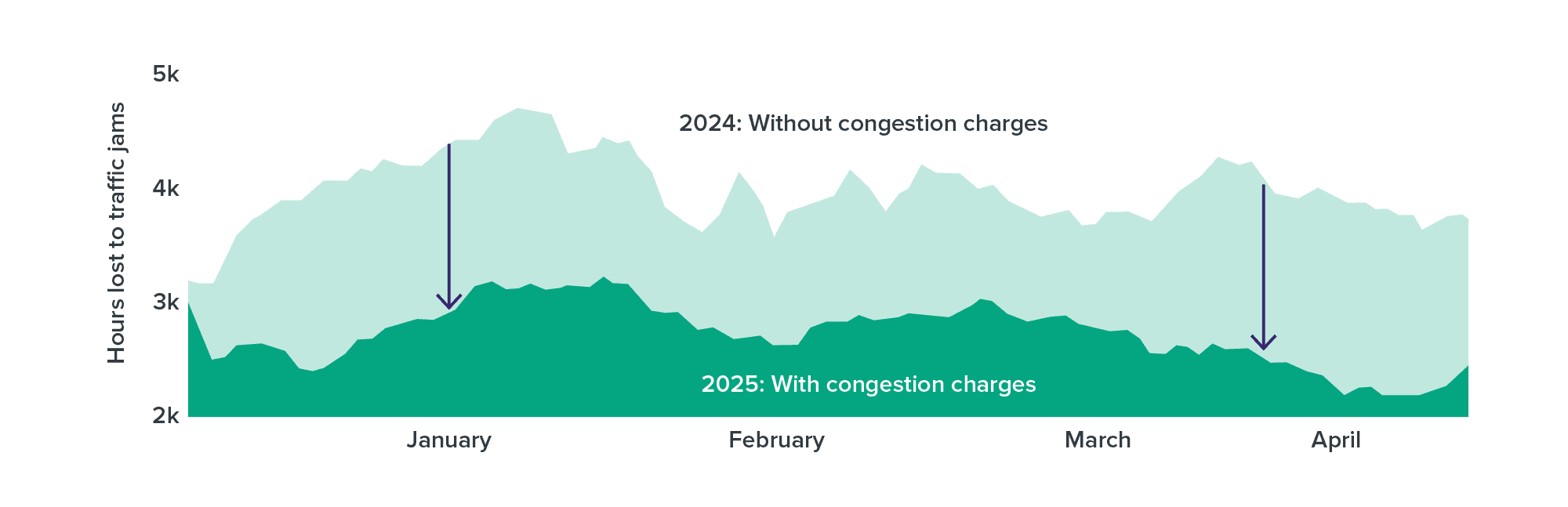
If left unchecked, rising congestion will make cities less attractive, costlier, and less productive. Building more capacity will help in targeted locations, but the greatest gains now lie in using existing roads better. Cities such as New York and Stockholm have shown that time-of-use charging, where drivers pay a bit more to use busy roads at peak times, can cut congestion substantially.
This approach shifts less-urgent trips to off-peak times and encourages public transport use, freeing up road space for those who need it most. Previous modelling for Auckland suggests time-of-use charging could cut excess delay by around 35% and deliver equivalent network performance with roughly 20% less new capital investment.52
Current road pricing tools – fuel excise duty (FED) and road user charges (RUC) – do not reflect the localised nature of congestion because they are set nationally. As the vehicle fleet becomes more fuel-efficient and more electric, universal RUC will become a fairer and more sustainable way to charge for road use, while also enabling more dynamic, location-based pricing in future.
Figure 22: Impact of time-of-use charging on congestion in New York
Time-of-use charging: New York (Manhattan)
25% reduction in congestion
Source: Regional Plan Association. ‘Congestion Pricing: Faster All Around’. (2025) https://rpa.org/news/lab/congestion-pricinggetting-around-faster-all-around

Key actions
- Implement time-of-use charging in Auckland. Enabling legislation is now in place, but durable central and local government support will be critical for designing and rolling out the first scheme.
- Partner with local government. Congestion pressures are concentrated in Auckland, Wellington, Christchurch, Tauranga, and Queenstown. Joint design, timing, and supporting investments will help ensure schemes are effective and publicly sustainable.
- Integrate pricing into investment decisions. Congestion charging will change travel patterns and the timing of future investment needs. Business cases should explicitly account for these effects to ensure the right investments are made at the right time.
- Support the transition to universal road user charges. Modernising the largely paper-based system and expanding it to 3.5 million vehicles will be complex, but it can make transport funding fairer and more transparent.
Financing tools spread the upfront costs of investment
Once appropriate pricing and funding methods are in place, infrastructure providers should consider how to finance the upfront costs of investment. Funding represents all the money needed to pay for infrastructure, which ultimately comes from users, taxpayers, or ratepayers. Financing is about when we pay for infrastructure. It involves borrowing money now and repaying it later. This allows developers to spread the cost of building and operating infrastructure over a longer period and pay for it using revenues raised by current and future users.
Many financing options are available. The Treasury’s ‘Funding and Financing Framework’ encourages consideration of all options.53 These range from comparatively simple options, like taking out bank loans or issuing government bonds, through to more complex options like establishing special purpose vehicles or public private partnerships to finance projects. Infrastructure providers can also raise cash for investment through ‘asset recycling’, which means selling existing assets to free up money to buy new ones. Increasingly, iwi entities are seeking a role in financing and owning infrastructure, through a range of mechanisms.