Long-term pipeline certainty, with confirmed funding, would enable the sector to build and maintain workforce capability and capacity, and avoid the boom-bust cycle we continue to experience, which is costly to the country and to individuals and their families.Infrastructure New Zealand submission
Content
Content

5.2 Improving the quality of project information
Te whakapai ake i te kounga o ngā mōhiohio kaupapa
Context
Accessible information is key for well-functioning markets. The New Zealand infrastructure sector has a low level of digital and data maturity. Prior to the development of the National Infrastructure Pipeline the sources of information about upcoming projects were fragmented and inconsistent. Infrastructure providers naturally focus on the delivery of their current infrastructure projects instead of investing in data assets and systems that will lift their capability to plan and deliver projects over the longer term.
The Pipeline is a transparency tool that provides a single source of information on projects in the planning and delivery phases around New Zealand. Central government agencies, almost all councils, and many private sector firms all feed into the Pipeline. While the process is voluntary, the Pipeline has grown from 21 contributing organisations to 129 since it was established in 2020.
The Pipeline provides details on the funding status of planned investments, as well as when they are expected to happen. This gives the construction sector greater certainty about future market activity, allowing them to prepare accordingly. Project funders can use the Pipeline to coordinate and sequence their investments, with an eye to workforce, supply chain and building materials requirements.
Realising the full benefits of the Pipeline depends on access to timely, quality and complete information. While there have been steady improvements over the last four years, information quality and completeness across sectors, organisations, and data fields remains variable. Information needed to support reviews and assess performance, like up-to-date project spending and completed costs, is difficult to access within a voluntary system. This holds back our ability to learn from projects and improve infrastructure planning and delivery.
Strategic direction
The National Infrastructure Pipeline helps coordinate when and how public investments occur
New Zealand needs to coordinate investment across sectors and between different infrastructure providers. This is particularly important for planning large projects or investment programmes in places with limited resources. In the short term, the capability of the construction industry and local infrastructure workforce may not be large enough to deliver everything that’s being planned, creating upward pressure on costs and additional delivery risks. Bringing together projects in one place helps infrastructure providers understand and identify market capacity constraints or opportunities when there will be more, or less, competition for labour and other resources. A well-informed, well-coordinated delivery pipeline helps achieve a more stable delivery schedule and reduces overall deliverability risk.
Workforce capacity constraints are particularly important after earthquakes and other natural hazard events that damage infrastructure. Rebuilding from these events is usually sequenced over multiple years, rather than delivered all at once. Sharing information through the Pipeline helps infrastructure providers understand collective recovery needs and have robust discussions around regional priorities and project sequencing. For example, the Pipeline was used to help collect and present information on the timing of recovery and rebuild initiatives after the 2023 North Island Weather Events, as well as modelling the workforce implications of the rebuild.
The Pipeline facilitates coordination between infrastructure providers. Because the Pipeline includes a large and growing share of planned infrastructure investment, it provides the most comprehensive view of anticipated demand, current constraints and sequencing opportunities. To support this, Pipeline information can be presented at a regional or sectoral level, and highlight investment themes, such as initiatives to recover from a natural hazard event.
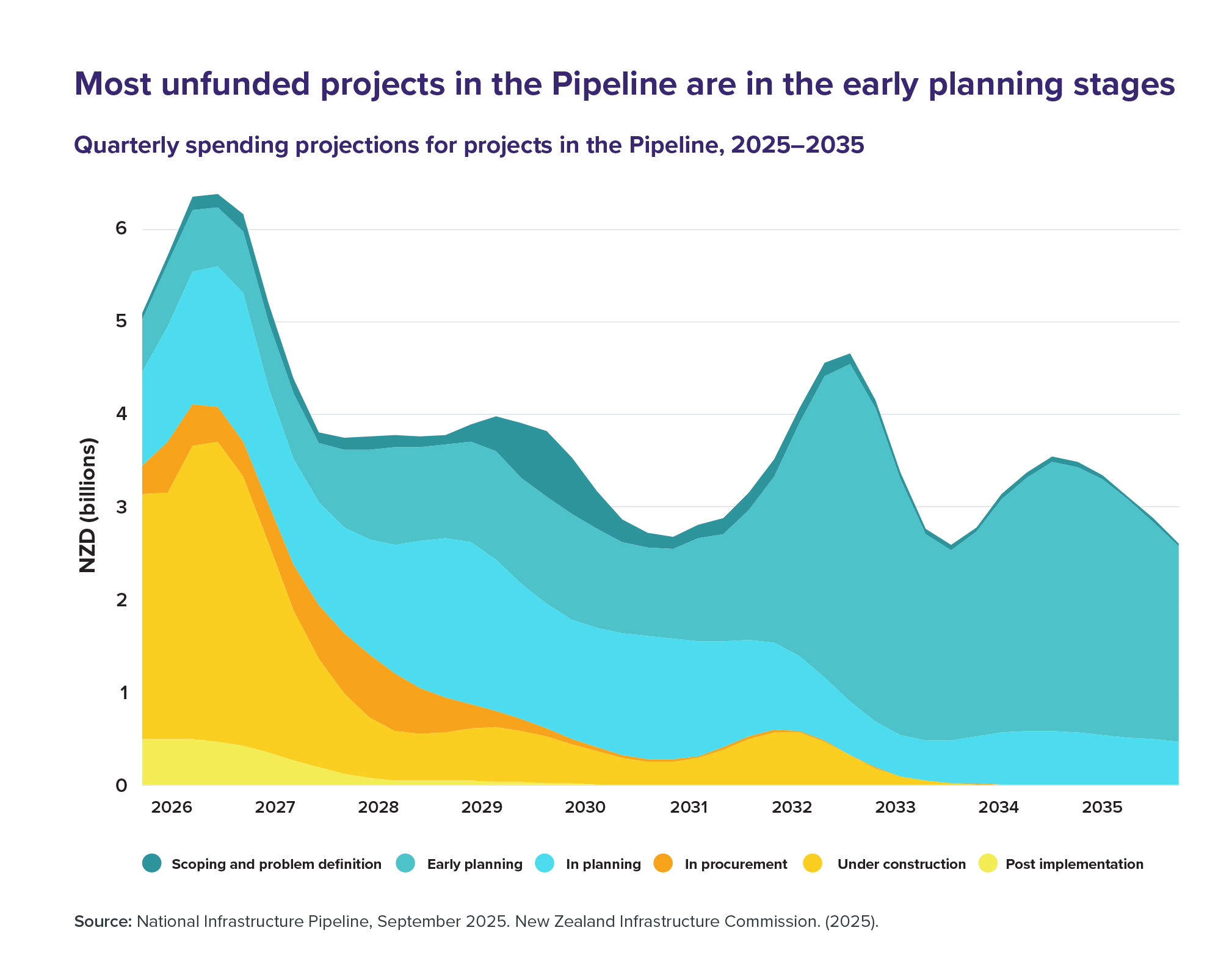
Most unfunded projects in the Pipeline are in the early planning stages
Figure 36: Quarterly spending projections for projects in the Pipeline, 2025–2035
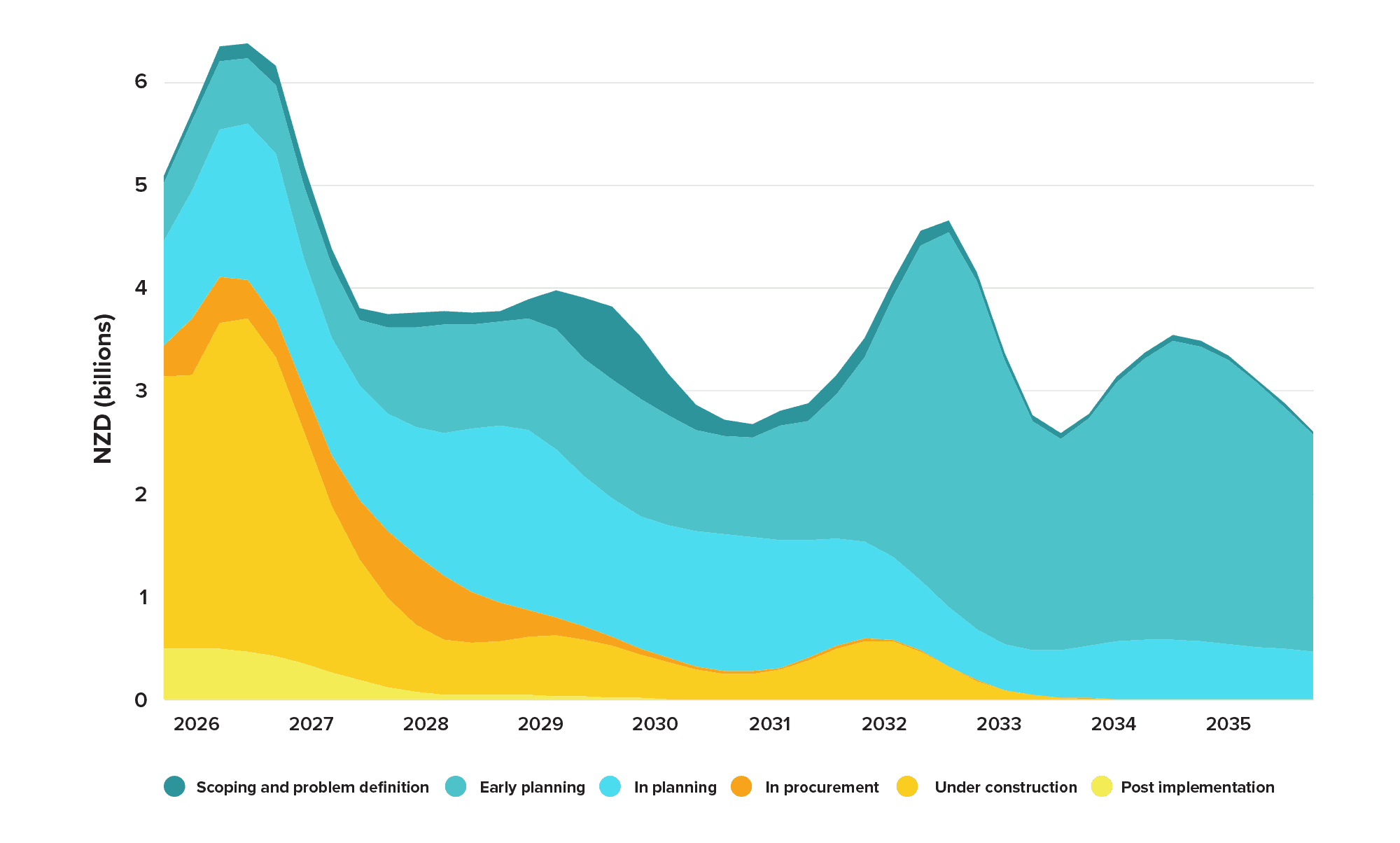
Source: National Infrastructure Pipeline, September 2025. New Zealand Infrastructure Commission. (2025).
Standardised project information collection enables effective portfolio management
Pipeline coverage should be extended to lift performance. Because the existing system is voluntary, submissions aren’t prioritised and providers don’t have sufficient incentives to invest in the digital and data capability necessary to provide consistent information. A stronger mandate for the Pipeline would lead to ongoing improvements and make it a more powerful and efficient tool for coordinating planning, learning from past projects, understanding market capacity, supporting performance reporting and investment reviews, informing workforce development, and strengthening system-wide evidence.
Common information standards should be adopted within the infrastructure system. This is important for reducing the costs to store, share and integrate information, as well as reducing the risk of inconsistent information being provided through different channels. Not everything needs to be standardised, but basic information should be available for all programmes and initiatives, and it should be possible to track these initiatives through their lifecycle and understand project performance.
The Pipeline supports efficient data collection and reduces duplication across government. Ongoing updates to the Pipeline can be used to gather new information for a specific purpose and integrate with information from across government. Requiring infrastructure providers to provide up-to-date information into the Pipeline will strengthen its application as a coordination tool. Decision-makers would also benefit from having consistent and comprehensive project data to inform their funding decisions.

Recommendation 10
Project information coordination
Require all infrastructure providers to maintain up-to-date data in the National Infrastructure Pipeline and strengthen arrangements for improving data quality over time.
Implementation pathway
This could be implemented by:
- Defining the National Infrastructure Pipeline in primary legislation with participation requirements for public and private providers.
- Empowering the Commission to set clear information requirements and standards for project and financial data, including business case information, actual project spend, and post-implementation reviews, thereby driving investment in agency capability.
- Auditing submissions to ensure compliance and completeness.
Responsible agencies
The Treasury (lead for policy work) and the New Zealand Infrastructure Commission for implementation
Timeframe
Begin work in 2026.