This article shares the views and perspectives of groups and individuals outside of Te Waihanga. Any opinions views expressed are not necessarily those of the Commission.
Raukawa is moving early to influence planning in a new resource management system.
The South Waikato iwi traces its origins to a common ancestor, Raukawa, a chief who was born more than 20 generations ago to a high-born East Coast woman, Māhina-a-rangi, and Tūrongo, a Rangatira descended from the Tainui waka.
Drawing on this historical legacy, the Raukawa Charitable Trust (RCT) has identified around 3,000 culturally important sites in and around their takiwā, or tribal boundaries.
The 500,000-hectare area includes growing population centres such as Te Awamutu, Matamata, Putāruru and Tokoroa, alongside significant natural features including the Kaimai Ranges and three main awa: the Waikato, Waihou and Upper Waipā rivers.
As Anaru Begbie, who heads Pūtake Taiao, the environment group within RCT, puts it: “Having lived on the land for 500 years, there's a deep amount of knowledge and understanding.
“You can’t replicate that.”
Reclaiming and recording cultural sites
Raukawa signed a deed of settlement with the Crown in 2012.
The ensuing legislation, passed in 2014, includes an account of the Crown invasion of the Waikato, which culminated in the three–day siege of the fortified pā at Ōrākau. In its apology, the Crown acknowledged how Raukawa was systematically dispossessed of their land through confiscation, private sales, and the seizure of land for public works, including roads and – later – hydroelectric schemes.
“We’ve been very heavily impacted by land loss and the impacts of that are still ongoing to this day,” Begbie says.
One consequence is that whānau may not know, or have connections to, sites of cultural significance – 95% of which, Begbie estimates, are on privately held land. The iwi began collecting information on the location and significance of these sites during the settlement process, drawing on ancestral knowledge and historical documents, including Māori Land Court minutes.
This identification process – which captures the coordinates of sites in a GIS database – was formalised as the Ngā Wāhi Tūturu me Ngā Taongā Tuku Iho programme. Through this work, Raukawa has begun developing relationships with landowners and creating management plans for significant sites. Every year, it undertakes a ‘truthing process’ to assess and categorise around 30 sites.
Among the ‘Category A’ sites are Te Kōhatu o Hatupatu (a distinctive rock near Kinleith that tells the story of the Raukawa kaitiaki Kurungaituku), the Ōrākau battlefield, and numerous pā sites and urupā, or burial grounds.
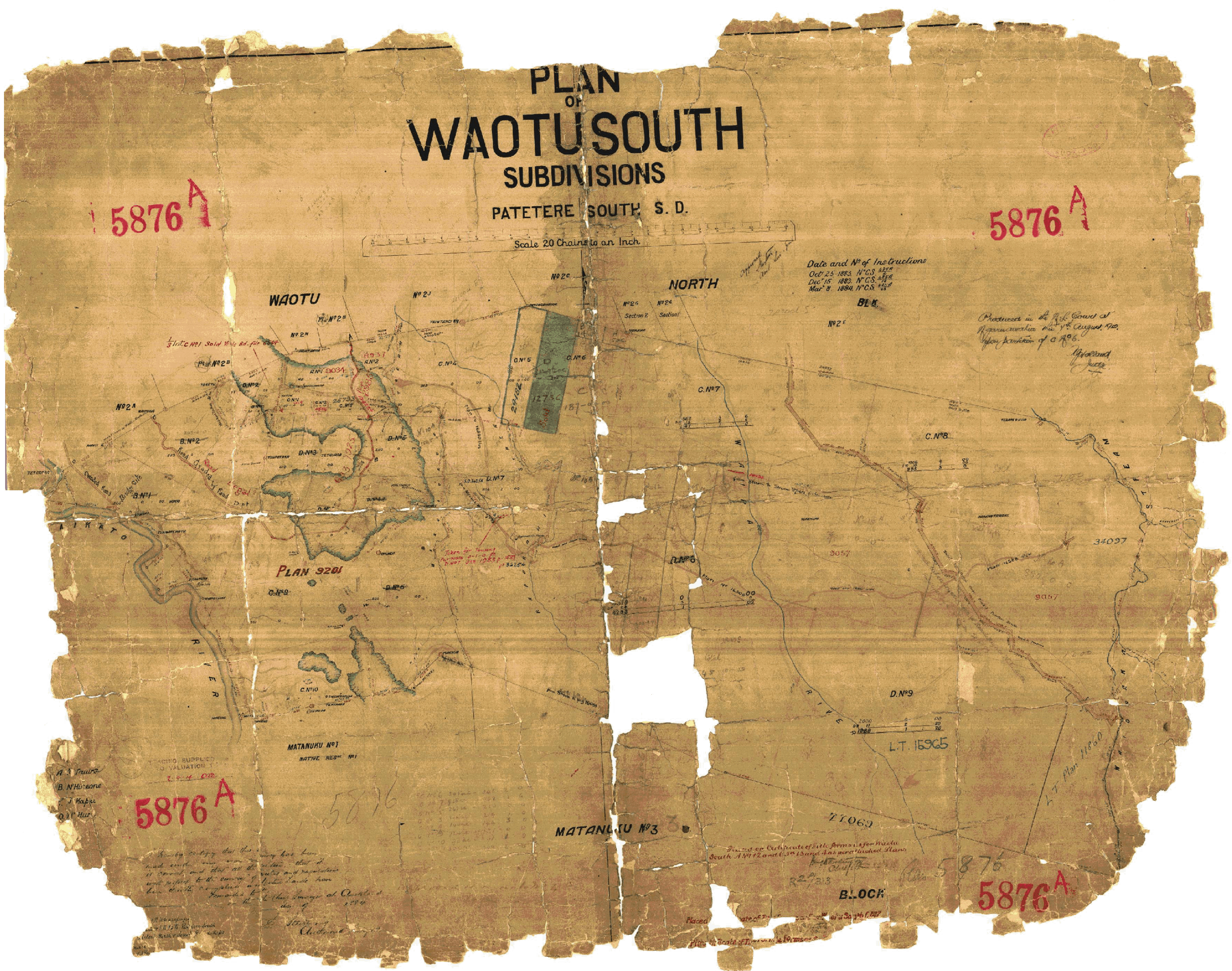
An old planning record from within the Raukawa - things have changed a lot since.
Since 2015, Begbie says the database has expanded to include additional information such as resource consent information, territorial authority and iwi boundaries, material from Heritage New Zealand and other central government agencies, and details on natural features including rivers and streams.
“We’re starting to build a really good repository of datasets that can help feed into a spatial strategy,” he says.
Raukawa is not just storing this information. In recent years, the iwi has begun using it to share stories and cultural knowledge. The Waipapa ki Arapuni Wāhi Ahurei project, for example, is an exercise in cultural landscape mapping. The dedicated website includes a series of visualisations tracing important ancestral journeys, as well as an interactive map showing pā sites in the Waipapa ki Arapuni area along the Waikato River, juxtaposed with current land uses.
Waipapa ki Arapuni Wāhi Ahurei
The Waipapa ki Arapuni Wāhi Ahurei project is an exercise in cultural landscape mapping. It includes a series of visualisations tracing important ancestral journeys, as well as an interactive map showing pā sites in the Waipapa ki Arapuni area along the Waikato River, juxtaposed with current land uses.
Feedback on the database and the resulting initiatives has been positive, Begbie says.
“It provides whānau the opportunity to learn more about themselves, to learn and strengthen those connections back to place, enhancing their cultural identity.”
From environmental plan to spatial strategy
The moment is well suited to developing a Raukawa–led spatial strategy. The Government is currently reforming the resource management system.
Our National Infrastructure Plan recommends that New Zealand commits to a durable framework that both enables infrastructure and protects the environment. The Plan notes that this is important for Māori, who have a deep connection with te whenua, and want new infrastructure to improve and integrate into the existing landscape, not damage it.
One of the features of the new resource management system is that every region will prepare a new “combined plan”. This will include a spatial plan that provides strategic direction for the next 30 years, and more detailed plans that regulate land use and use of the natural environment. The National Infrastructure Plan emphasises the importance of these plans helping to align land use planning and infrastructure investment.
The reform will require all local authorities to work together to develop a regional plan, and for each regional spatial planning committee to consult with relevant iwi. Central government will also be involved in the development of the plans.
Consultation, Begbie says, isn’t enough to meet iwi expectations of the Crown under Te Tiriti o Waitangi / The Treaty of Waitangi.
“We need to be more than just consulted on this. We need to be engaged and part of the development process.”
In 2015, Raukawa released an environmental management plan, Te Rautaki Taiao a Raukawa. A 2010 law enshrining a role for Raukawa in the management of the Waikato River (including its tributaries and the wider catchment) clearly states that local authorities must have regard to these iwi–developed plans.
The push to develop a Raukawa–specific spatial strategy stems from the need to update Te Rautaki and reconsider how the information it contains – including the environmental aspirations and values held by Raukawa – is presented.
It’s really important, in my mind, that councils work alongside iwi partners to develop these plans... They will really set the foundations for what the country looks like.
“We’re considering whether we present it as a type of spatial strategy,” Begbie says.
As Te Rautaki notes, the Raukawa takiwā has been a focal point for substantial infrastructure development over the past 150 years. While these schemes have brought community benefits, they have also harmed mana whenua.
“The sale of land for early land schemes and confiscation of land for public works has decimated the Raukawa relationship with our lands, and left us with a fraction of our ancestral whenua within our control,” the document reads.
In developing their own spatial strategy, Begbie says Raukawa aims to protect the taiao, as well as culturally significant sites, by identifying areas where development should not occur – and where it could occur within defined environmental limits.
"For us it’s about being proactive in this space and less reactive,” he says.
"There’s a perception that we slow processes down, however we’re frequently in a position where we’re reacting to things outside our control. When processes are followed correctly and we’re involved early, many of these delays can be avoided."
As Begbie points out, Raukawa will have access to information the Waikato Regional Council does not have, and vice versa. While there is some wariness about sharing details of culturally significant sites – due to past incidents where sites have been vandalised or damaged – he believes the Raukawa strategy will ultimately inform and elevate the Waikato regional combined plan.
“It’s really important, in my mind, that councils work alongside iwi partners to develop these plans,” he says. “They will really set the foundations for what the country looks like.”
Raukawa has been on the land for 500 years. The work being done now could shape how the Raukawa takiwā grows and changes for the next 20 generations of Ngā Uri o Raukawa, and whether the right balance is struck between cultural, economic, environmental and social values.
Published 12 June 2025