
New Zealand clearly values its infrastructure. We have been building infrastructure for generations, and our investment in infrastructure as a share of GDP is amongst the highest of high-income countries.
We will need to continue investing to ensure our infrastructure is fit for the future, but we can’t afford everything, so trade-offs are necessary. The National Infrastructure Plan’s goal is to inform how we can achieve the right level and mix of investment over the next 30 years.
Our Forward Guidance sets out what an affordable level and mix of infrastructure investment could look like over the next 30 years. It provides an independent view of a sustainable investment path.
We will continue to do periodic updates to provide ongoing forward guidance on what level of investment is affordable and what mix of investment will best meet our long-term demands for infrastructure.
Key findings
- We forecast future demand for infrastructure by considering various drivers of infrastructure demand. These include the need to renew and replace existing infrastructure assets, respond to demographic changes, economic growth and climate change, and prepare for natural hazards.
- Our analysis suggests demand for infrastructure investment will increase from around $20 billion today to slightly more than $30 billion by the 2050s (in 2023 NZD terms).
- While the total spend on infrastructure will increase, the ‘share of our wallet’ spent on investment is expected to remain at levels similar to the last 30 years.
- Our analysis indicates infrastructure investment will average around 6% of GDP over the next 30 years. While there are many different scenarios that could lead to higher or lower investment, we expect investment to fall between a range of 5% to 7% of GDP.
- Renewing and replacing assets we currently have will account for the majority of investment demands, and up to 80% of investment requirements in some sectors.
- We expect the mix of investment to change. Electricity and hospitals are key areas of future growth, whereas land transport and water investment will ease from its recent highs.
- When comparing our infrastructure with other countries that have similar incomes, geographic, and populations, we find that New Zealand typically has higher levels of spending, but not necessarily more infrastructure, more optimal usage, or higher quality infrastructure.
Forward Guidance analysis: Summary results and findings
Download
Supporting technical reports
The Forward Guidance quantitative model forecasts capital investment levels required to meet infrastructure needs due to various drivers of infrastructure demand.
The purpose of this document is to provide details on technical aspects of the models, such as key assumptions and inputs, which can help people to understand how they work.
The Forward Guidance aims to take a comprehensive view of infrastructure needs. We consider the international benchmarking as complementary to this analysis.
The purpose of this document is to detail the sources, methods, and metrics used to benchmark infrastructure networks across countries. It sets out the various assumptions used in the weighting of various metrics.
The Forward Guidance investment forecast is made at a national level. However, infrastructure investment requirements will differ across the country over the next 30 years.
This report, completed by Motu Research for the Commission, provides the analysis and modelling for disaggregating our national forecast to the regional level.
The Forward Guidance attempts to forecast different drivers of investment demand, one of which is responding to natural hazard risk.
This report, completed by Earth Sciences New Zealand for the Commission, provides the analysis for our projections of investment needed to repair after natural hazards. It estimates the long-run annual damages to infrastructure from six different natural hazards across horizontal and vertical infrastructure.
The National Infrastructure Plan includes a section estimating what our Forward Guidance investment path means for households.
This technical report provides details on the sources and modelling assumptions for that analysis. The report and model was developed by Crow Advisory for the Infrastructure Commission.
The National Infrastructure Plan with our Forward Guidance lays out how central government can sequence major investments over time to align with demand and long-run affordability. The National Infrastructure Plan provided advice for two sectors: land transport and hospitals.
The paper documents our analysis, modelling, and assumptions for that work.
The Forward Guidance attempts to forecast different drivers of investment demand, one of which is meeting our emissions goals.
This report, prepared by Motu Research for the Commission, provides the underlying analysis for our projections of investment required for decarbonisation in the electricity and land transport sectors.
While our Forward Guidance provides a national view of long run infrastructure investment, we understand the infrastructure requirements of Māori communities often differ from those of the wider population.
This report, developed by Nicholson Consulting for the Commission, provides background information and analysis for the Forward Guidance and other parts of the National Infrastructure Plan.
Published on 17 February 2026
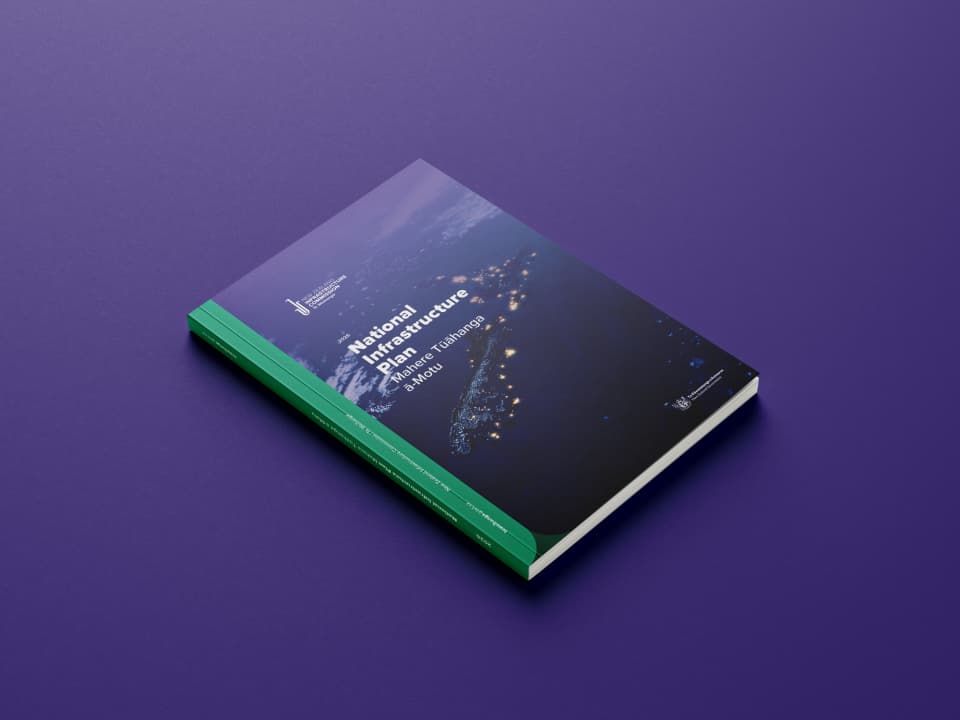
National Infrastructure Plan
The National Infrastructure Plan sets out a 30-year pathway for improving how New Zealand plans and delivers infrastructure.